Leaked Source Code Explained: What It Means for Your Data Safety
When developers accidentally publish the blueprints of a software application, attackers gain immediate access to hidden backdoors and unpatched security flaws that ordinary users cannot see.

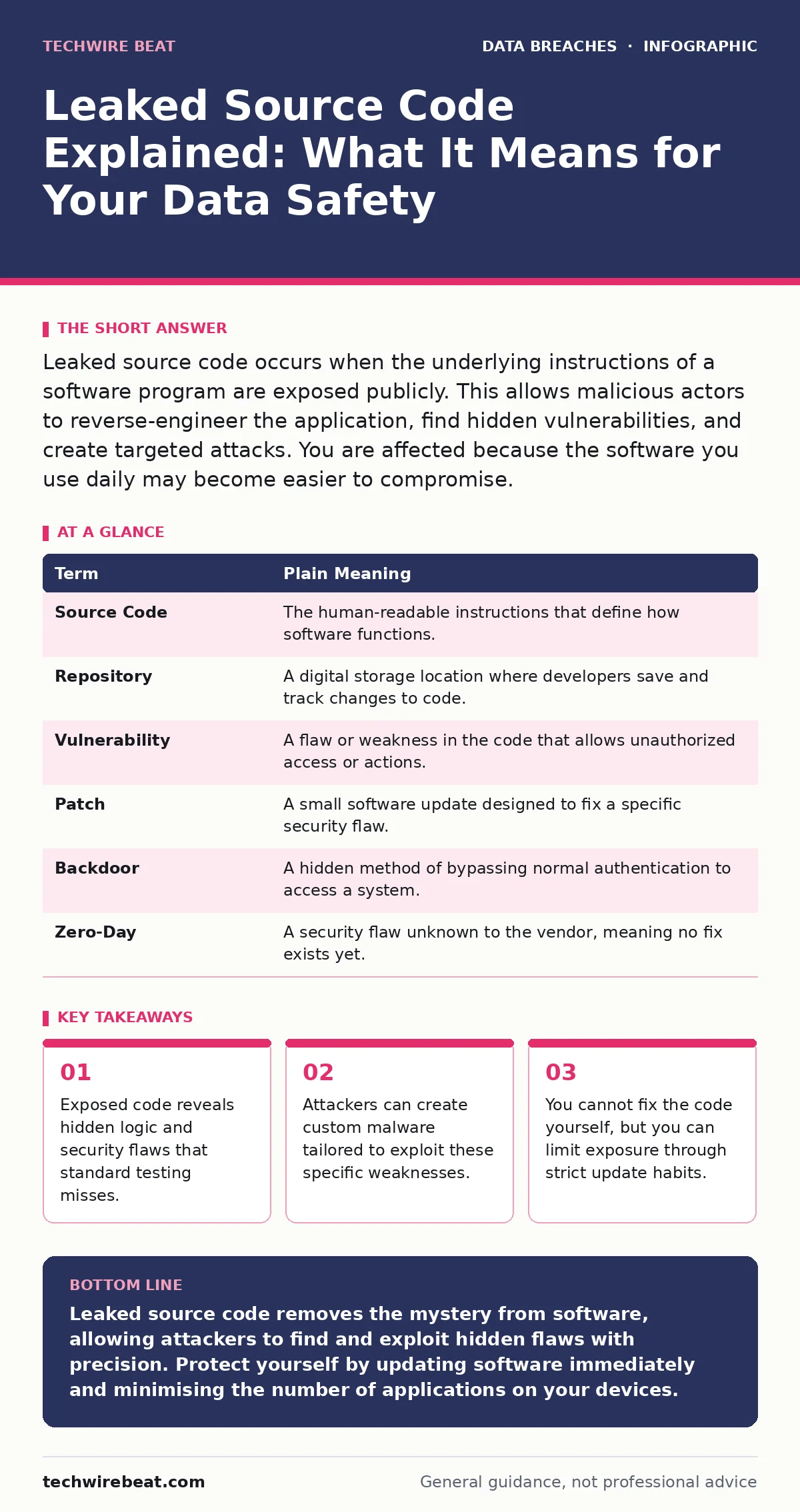
Leaked source code occurs when the underlying instructions of a software program are exposed publicly. This allows malicious actors to reverse-engineer the application, find hidden vulnerabilities, and create targeted attacks. You are affected because the software you use daily may become easier to compromise.
The Blueprint Analogy
Imagine a house builder who loses the architectural plans in a public park. The house itself still stands with its doors and windows intact. However, anyone who finds those plans knows exactly where the structural supports are weak, where the emergency exits hide, and how the alarm system is wired. They do not need to break down the front door. They can simply walk through a window they now know is unlocked or bypass the alarm using a trick only the builder knew. Source code is the blueprint of software. When it leaks, the digital house becomes transparent to those holding the plans.
What Source Code Actually Is
Source code is the set of written instructions that tells a computer how to perform specific tasks. Developers write these instructions in programming languages that humans can read, before converting them into machine code that computers execute. This human-readable version contains comments, logic flows, and security checks. It is the raw material of any application, from your banking app to your operating system. Keeping this material private prevents outsiders from understanding the internal mechanics of the software. It forces attackers to guess at how the system works, which is a slow and difficult process.
| Term | Plain Meaning |
|---|---|
| Source Code | The human-readable instructions that define how software functions. |
| Repository | A digital storage location where developers save and track changes to code. |
| Vulnerability | A flaw or weakness in the code that allows unauthorized access or actions. |
| Patch | A small software update designed to fix a specific security flaw. |
| Backdoor | A hidden method of bypassing normal authentication to access a system. |
| Zero-Day | A security flaw unknown to the vendor, meaning no fix exists yet. |
The Hidden Danger of Exposure
The immediate risk is not that the code is stolen, but that it is read. Attackers use automated tools to scan leaked code for patterns associated with security flaws. They look for hardcoded passwords, insecure data handling, or missing input validations. This allows them to identify zero-day vulnerabilities before the developer even knows they exist. Once an attacker finds a flaw, they can craft an exploit specifically designed to trigger it. This is far more effective than random hacking attempts. The leak turns a black box into a clear box, removing the primary defence of obscurity.
Impact on Ordinary Users
You do not write code, so why should this concern you? Because the software you use is built on this foundation. If the underlying code is compromised, the applications you trust may behave unexpectedly. Your data could be intercepted, or your device could be used to attack others. This often leads to customer data exposure when the compromised software handles sensitive information. It is not just about large corporations; even small apps can become entry points for broader data breaches. The integrity of your digital environment depends on the security of the code running behind the scenes.
The Limits of Your Control
You cannot review the source code of most commercial applications. You rely on the developers to write secure code and keep it private. This dependency introduces a layer of risk known as vendor risk management. If a vendor fails to secure their development environment, you inherit their mistakes. This is why third-party software is often the weakest link. It is not enough to secure your own devices; you must also consider the security practices of the companies whose software you install. Trust is a necessary component of computing, but it must be informed and cautious.
See also: Credential Dumps Explained: How Stolen Passwords Work · Insider Data Theft Prevention Checklist for Secure Operations
Simple Safety Habits
You can mitigate the risk of leaked code by changing how you interact with software. First, enable automatic updates for all applications. This ensures you receive patches as soon as developers fix discovered flaws. Second, minimise the number of applications installed on your devices. Each program is a potential entry point. Third, use an application firewall to monitor what programs are allowed to communicate with the internet. This limits the damage if a piece of code is compromised. These habits do not prevent leaks, but they reduce the time window attackers have to exploit them.
- Enable automatic updates for your operating system and all installed apps.
- Uninstall applications you no longer use or do not trust.
- Configure your firewall to block unnecessary outgoing connections.
Beyond Code Leaks
Understanding code leaks helps you appreciate the broader security ecosystem. For instance, encryption in transit protects your data even if the application logic is flawed. It ensures that data moving between your device and a server remains unreadable to outsiders. Similarly, robust backup strategies ensure you can recover your data if an attack succeeds. These layers of defence work together. No single measure is sufficient, but combined, they create a resilient environment. Always consider how one failure might cascade into another.
Key takeaways
- Exposed code reveals hidden logic and security flaws that standard testing misses.
- Attackers can create custom malware tailored to exploit these specific weaknesses.
- You cannot fix the code yourself, but you can limit exposure through strict update habits.
Leaked source code removes the mystery from software, allowing attackers to find and exploit hidden flaws with precision. Protect yourself by updating software immediately and minimising the number of applications on your devices.
Frequently asked questions
Can I check if my software's code has been leaked?
Generally, no. You would need to monitor security news or vulnerability databases for announcements regarding specific applications you use.
Does open-source software have this problem?
Open-source code is public by design, but it is reviewed by many experts. Leaked proprietary code is dangerous because it is not intended for public scrutiny or review.
How do developers prevent their code from leaking?
Developers use access controls, encryption, and secure storage for their code repositories. They also train staff to avoid accidentally uploading sensitive files to public platforms.
Is antivirus software enough to protect against leaked code exploits?
Antivirus helps, but it often relies on known signatures. Exploits derived from leaked code may be new and unrecognised by antivirus databases, making updates more effective.
How this guide was produced: written by the TechWire Beat editorial team with AI assistance, checked against the public references listed below, and reviewed when the facts change. See our editorial policy or report an error.