Insider Data Theft Prevention Checklist for Secure Operations
Most data exfiltration originates from trusted accounts, making behavioural monitoring more effective than perimeter firewalls in detecting internal threats.

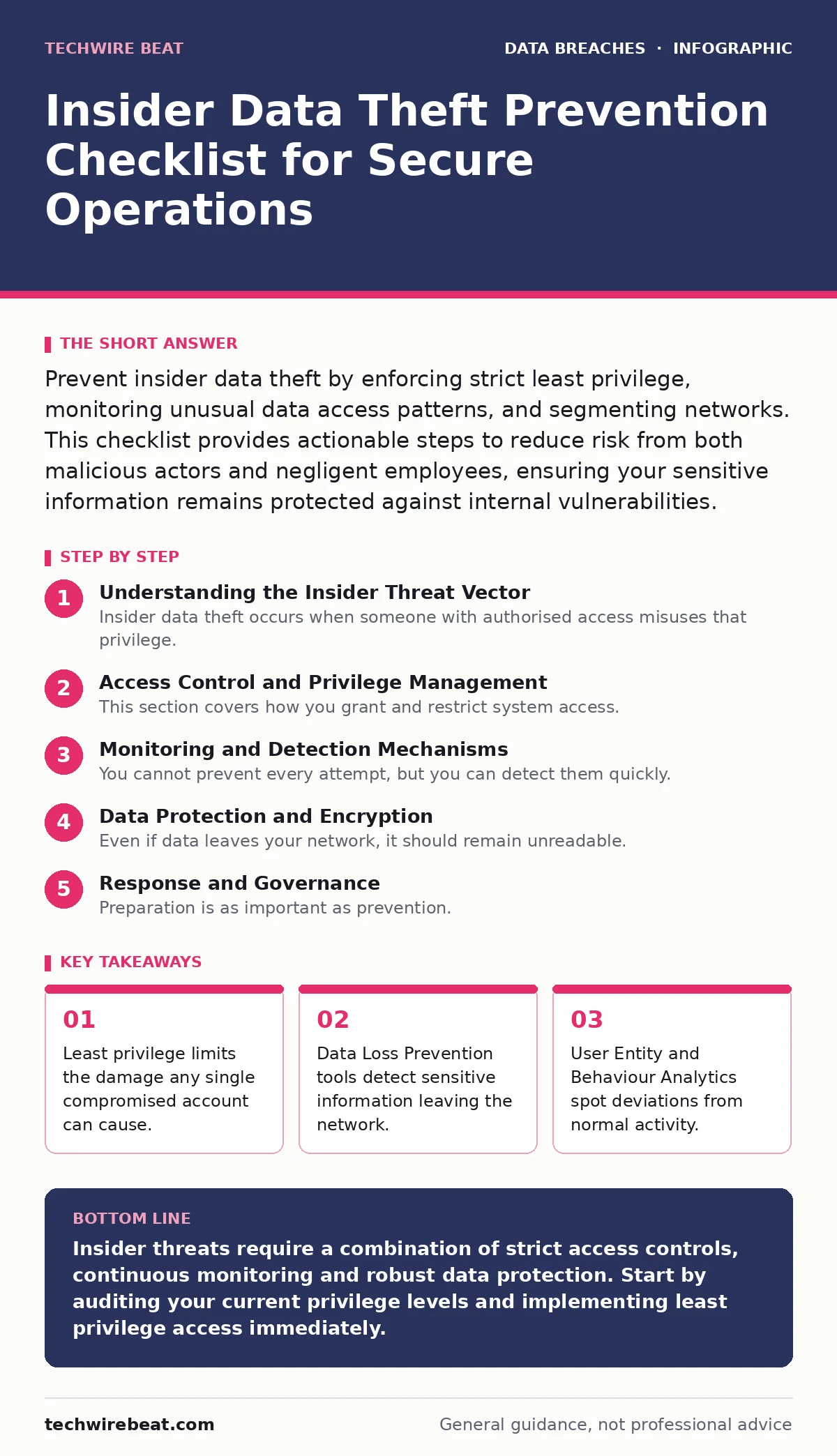
Prevent insider data theft by enforcing strict least privilege, monitoring unusual data access patterns, and segmenting networks. This checklist provides actionable steps to reduce risk from both malicious actors and negligent employees, ensuring your sensitive information remains protected against internal vulnerabilities.
Understanding the Insider Threat Vector
Insider data theft occurs when someone with authorised access misuses that privilege. This group includes current employees, former staff, contractors and partners. The risk is not limited to malicious intent. Negligence, such as misconfiguring a cloud storage bucket, often causes more damage than deliberate sabotage. You must treat internal access as a potential attack vector. Trust alone is not a security control. Verification and monitoring are required to maintain integrity.
Access Control and Privilege Management
This section covers how you grant and restrict system access. The goal is to ensure users have only the permissions they need to perform their specific job functions.
- Implement least privilege access: Users receive only the minimum permissions required for their role, reducing the attack surface.
- Enforce role-based access control: Permissions are tied to job titles rather than individuals, simplifying management and reducing errors.
- Require multi-factor authentication for sensitive data: Adding a second verification step prevents attackers from using stolen credentials alone.
- Conduct regular access reviews: Managers confirm that employees still need their current permissions, removing unnecessary access rights.
- Segment network zones: Critical data is isolated from general corporate networks, limiting lateral movement if an account is compromised.
Least privilege is not just a best practice. It is a fundamental design principle. When every user has admin rights, a single phishing click can expose your entire database. Segmenting your network ensures that even if an insider bypasses one layer, they cannot easily reach the most valuable assets. This approach adds complexity to your infrastructure but significantly reduces the blast radius of any breach.
Monitoring and Detection Mechanisms
You cannot prevent every attempt, but you can detect them quickly. Monitoring tools look for behaviour that deviates from the norm. This is where User Entity and Behaviour Analytics comes into play. These systems learn what normal activity looks like for each user. They flag anomalies, such as logging in at unusual hours or downloading large volumes of files.
- Deploy Data Loss Prevention software: DLP tools scan outbound traffic for sensitive patterns like credit card numbers or source code.
- Enable detailed audit logging: Every access attempt and data modification is recorded, creating a trail for forensic analysis.
- Monitor for large data transfers: Sudden spikes in data volume often indicate exfiltration attempts, requiring immediate investigation.
- Track privileged user activity: Administrators have broad access, so their actions require closer scrutiny and higher alert thresholds.
- Integrate logs with a SIEM: A Security Information and Event Management system correlates data from multiple sources to identify complex threats.
Detection relies on the quality of your baseline. If your monitoring system flags every email sent, you will suffer from alert fatigue. Tune your rules to focus on high-risk actions. For example, accessing customer databases from an unmanaged device is a significant red flag. Combine technical controls with human oversight. Automated systems catch patterns, but analysts interpret context. This combination ensures you do not miss subtle signs of compromise.
Data Protection and Encryption
Even if data leaves your network, it should remain unreadable. Encryption transforms plain text into ciphertext, which is useless without the decryption key. This is particularly important for data at rest and data in transit. You should also consider how you handle personally identifiable information. Minimising the amount of sensitive data you store reduces the value of your systems to attackers.
- Encrypt data at rest: Stored files and databases are encrypted, protecting them if physical devices are stolen.
- Encrypt data in transit: Network traffic is secured using protocols like TLS, preventing interception during transmission.
- Implement secrets management: API keys and passwords are stored in secure vaults, not in code repositories or configuration files.
- Classify data by sensitivity: Knowing which data is critical allows you to apply stronger protections where they matter most.
- Use digital rights management: DRM controls who can open, print or copy files, even after they leave your network.
Encryption is not a silver bullet. If an insider has the decryption keys, encryption provides no protection. This is why secrets management is critical. Keys must be rotated regularly and stored separately from the data they protect. Additionally, consider your backup strategies. If backups are not encrypted or are easily accessible, they become a secondary target. Ensure your backups are immutable and isolated from the primary network.
See also: AI Governance for Small Teams: Practical Controls and Cost
Response and Governance
Preparation is as important as prevention. When an insider threat is detected, you must respond quickly and legally. This involves having clear policies and procedures in place. You should also be aware of breach notification laws. Depending on your jurisdiction, you may have strict timelines for reporting incidents. Delaying notification can result in severe penalties and reputational damage.
- Establish an insider threat policy: Clear rules define acceptable use and consequences for violations, setting expectations for all staff.
- Create an incident response plan: Step-by-step procedures guide your team through containment, investigation and recovery.
- Train employees on security awareness: Regular training helps staff recognise social engineering and understand their role in security.
- Conduct off-boarding audits: Access rights are revoked immediately when employees leave, preventing former staff from accessing data.
- Review vendor risk management: Third-party partners often have access to your systems, requiring similar security standards.
Governance ensures consistency. Without clear policies, responses to incidents are ad hoc and ineffective. Training reinforces these policies, making security a shared responsibility. Off-boarding is a critical control point. Many breaches occur because former employees retain access. Automating the revocation of access rights reduces this risk. Finally, remember that vendor risk management extends your security perimeter. Your partners’ weaknesses can become your vulnerabilities.
Key takeaways
- Least privilege limits the damage any single compromised account can cause.
- Data Loss Prevention tools detect sensitive information leaving the network.
- User Entity and Behaviour Analytics spot deviations from normal activity.
Insider threats require a combination of strict access controls, continuous monitoring and robust data protection. Start by auditing your current privilege levels and implementing least privilege access immediately.
Frequently asked questions
How do I distinguish between a malicious insider and a negligent employee?
Malicious insiders act with intent to harm or steal, while negligent employees make mistakes due to lack of training or care. Monitoring intent and pattern helps differentiate them.
Is it legal to monitor employee activity?
Laws vary by region, but generally, you can monitor work devices and networks if employees are informed. Always consult legal counsel to ensure compliance with local privacy regulations.
What is the most common method of insider data theft?
Removable media devices like USB drives and cloud storage services are frequently used. Employees copy sensitive data to personal devices for convenience or malicious purposes.
How often should I review access permissions?
Quarterly reviews are recommended for high-risk roles. Annual reviews are acceptable for low-risk positions, but immediate revocation is required upon role change or departure.
How this guide was produced: written by the TechWire Beat editorial team with AI assistance, checked against the public references listed below, and reviewed when the facts change. See our editorial policy or report an error.