Data Loss Prevention Definition: How DLP Stops Sensitive Data Escaping
DLP systems often block legitimate work by misreading context, creating a hidden tax on employee productivity that exceeds the cost of minor leaks.

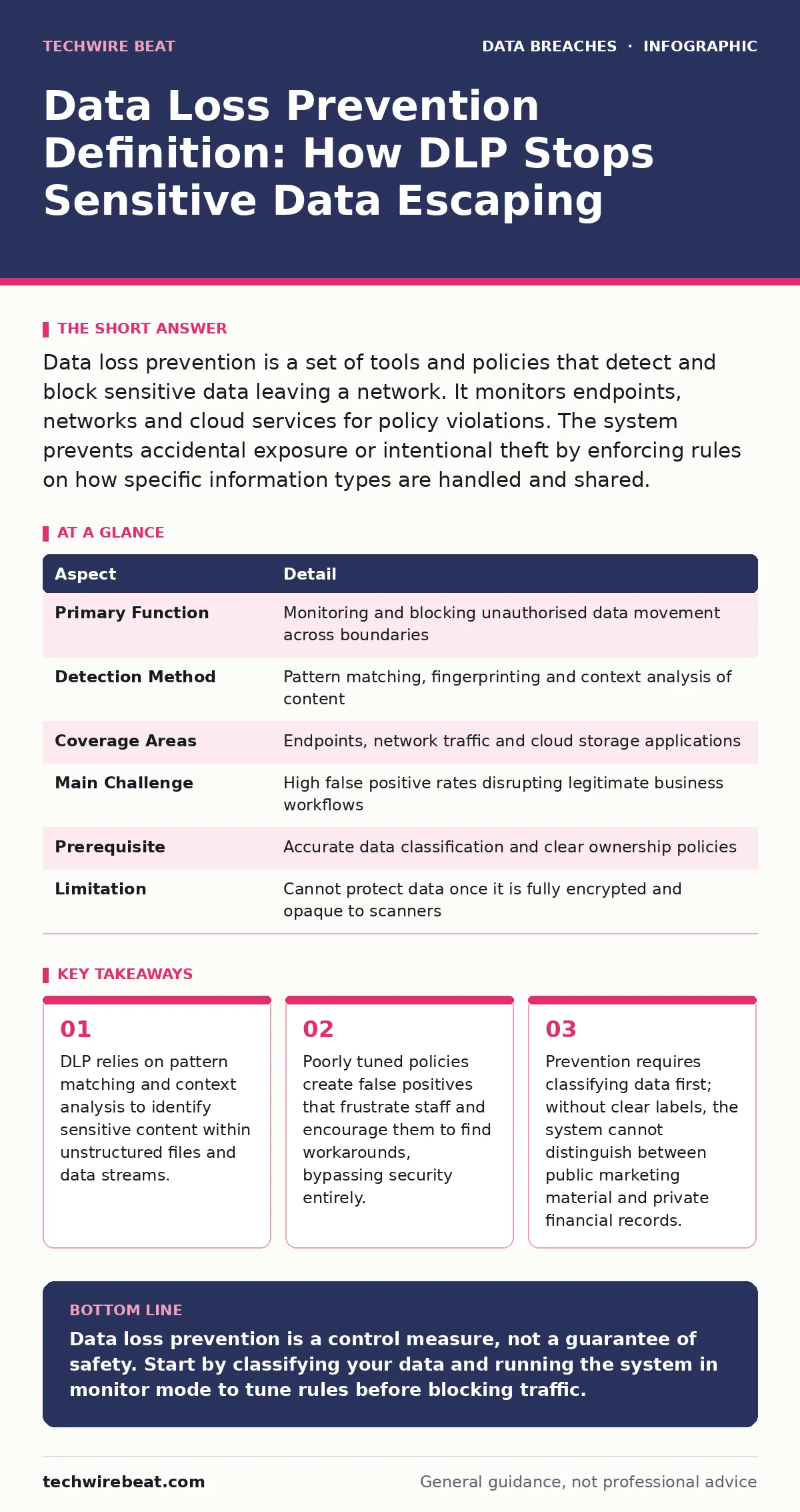
Data loss prevention is a set of tools and policies that detect and block sensitive data leaving a network. It monitors endpoints, networks and cloud services for policy violations. The system prevents accidental exposure or intentional theft by enforcing rules on how specific information types are handled and shared.
The Post Office Analogy for Data Control
Imagine your organisation is a busy post office. Employees pack letters, parcels and boxes every day. Most of these items are harmless invoices or marketing flyers. Some contain passports, bank statements or medical records. A human sorter might miss a sensitive document slipping into the general mail stream. Data loss prevention acts as an automated scanner at the exit door. It opens every envelope, reads the label and contents, and compares them against a rulebook. If the rulebook says "passports must go via registered courier," the system stops the standard mail and reroutes it.
This analogy highlights the core function. The system does not care about the employee's intent. It cares about the content and the destination. A well-meaning worker sending a contract to a partner is treated the same as a malicious actor exfiltrating trade secrets. The mechanism is blind to motive, relying entirely on predefined rules about what data is sensitive and where it is allowed to go.
| Aspect | Detail |
|---|---|
| Primary Function | Monitoring and blocking unauthorised data movement across boundaries |
| Detection Method | Pattern matching, fingerprinting and context analysis of content |
| Coverage Areas | Endpoints, network traffic and cloud storage applications |
| Main Challenge | High false positive rates disrupting legitimate business workflows |
| Prerequisite | Accurate data classification and clear ownership policies |
| Limitation | Cannot protect data once it is fully encrypted and opaque to scanners |
Data Loss Prevention Definition and Core Mechanics
Data loss prevention definition centres on the ability to inspect data in motion, at rest and in use. In motion refers to data moving across the network, such as emails or file transfers. At rest covers data stored on servers, laptops or cloud drives. In use involves data actively being manipulated by applications or users. The system applies rules to these three states. It looks for specific patterns, such as credit card numbers following a standard format, or unique strings of text that match known confidential documents.
The engine works by scanning content against a database of rules. These rules can be simple, like blocking any file with the word "secret" in the name. They can also be complex, using machine learning to understand the context of a sentence. If a user copies a paragraph containing customer names and paste it into a personal email client, the system flags it. The decision to block, quarantine or allow the transfer depends on the policy. A strict policy blocks everything. A balanced policy might allow the transfer but alert a security team for review.
Who Bears the Cost of Prevention
You might assume DLP only protects the IT department. The reality is that it affects every person who handles information. Employees face friction when their routine tasks are interrupted by security warnings. A salesperson trying to send a large proposal might find the upload blocked because the file contains a few customer phone numbers. The delay costs time and momentum. Managers must define what is sensitive, a task that requires legal and operational knowledge. Security teams spend hours tuning the system to reduce noise.
The organisation itself bears the risk of over-blocking. If the system is too aggressive, staff will find ways to bypass it. They might use personal USB drives, send data via personal messaging apps or take photos of screens. This behaviour creates shadow IT channels that are completely invisible to the security tools. The cost is not just technical; it is cultural. Trust erodes when employees feel they are being watched rather than protected. Understanding this dynamic is key to implementing effective controls. See also insider data theft for how internal actors exploit these friction points.
What to Do About Implementation Gaps
Start by mapping your data. You cannot protect what you cannot find. Identify where your most valuable information lives. Is it in a central database, shared drives or local laptops? Classify this data into tiers. Public information can go anywhere. Internal data should stay within the company. Confidential data needs strict controls. This classification feeds the DLP rules. Without it, the system guesses and guesses wrong.
Deploy the system in monitor mode first. Do not block traffic immediately. Let the system run for weeks and observe what it flags. You will see many false positives. Legitimate emails containing public information might trigger alerts because of a keyword. Use this period to refine the rules. Adjust the sensitivity. Exclude known safe patterns. Only when the false positive rate is low should you switch to blocking mode. This gradual approach prevents business disruption.
The Hidden Cost of False Positives
The most dangerous aspect of DLP is not a breach, but the fatigue it creates. When users receive constant alerts, they stop reading them. They click "approve" without looking. This is known as alert fatigue. The system becomes a rubber stamp. Real threats slip through because the signal is lost in the noise. You must balance security with usability.
Consider the trade-off. Tighter rules mean more protection but more friction. Looser rules mean smoother work but higher risk. There is no perfect setting. You must find the point where the risk is acceptable. This often means accepting that some low-value data will leak. Trying to stop every single byte of information is impossible and counterproductive. Focus on high-value assets. Protect the crown jewels. Let the dust settle on the rest.
See also: AI Governance for Small Teams: Practical Controls and Cost · Privacy Laws For Small Businesses: The Hidden Security Advantage
What People Usually Get Wrong
Many believe DLP is a silver bullet. It is not. It cannot stop a user from writing down a password on a sticky note. It cannot prevent a hacker from stealing data that has already left the network via a compromised cloud account. It also struggles with encrypted traffic. If data is encrypted in transit, the DLP system cannot see inside the packet. It sees only gibberish. This is why encryption in transit is a separate control. DLP needs to inspect the data before it is encrypted or after it is decrypted at the endpoint.
Another common error is assuming DLP replaces user training. Technology fails when people do not understand why it exists. Users who know the business impact of a leak are more likely to follow procedures. They view DLP as a helper, not a hindrance. Combine technical controls with clear communication. Explain what is being protected and why. This reduces resistance and improves compliance. See also breach notification laws to understand the legal fallout when prevention fails.
Beyond Traditional Boundaries
Modern work environments blur the lines. Employees use personal devices, cloud apps and remote servers. Traditional network-based DLP cannot see traffic that bypasses the corporate firewall. Endpoint DLP agents on laptops and phones are necessary. They monitor data on the device itself. Cloud Access Security Brokers sit between users and cloud services. They inspect data entering and leaving platforms like email or storage services. This layered approach ensures coverage regardless of where the user is.
Integrating DLP with other security tools improves effectiveness. If a user account shows suspicious activity, the DLP system can tighten its rules for that user automatically. This contextual awareness makes the system smarter. It reacts to threats in real-time. It moves from static rules to dynamic protection. This evolution is necessary as attackers become more sophisticated and data moves faster.
Key takeaways
- DLP relies on pattern matching and context analysis to identify sensitive content within unstructured files and data streams.
- Poorly tuned policies create false positives that frustrate staff and encourage them to find workarounds, bypassing security entirely.
- Prevention requires classifying data first; without clear labels, the system cannot distinguish between public marketing material and private financial records.
Data loss prevention is a control measure, not a guarantee of safety. Start by classifying your data and running the system in monitor mode to tune rules before blocking traffic.
Frequently asked questions
Does data loss prevention stop all data leaks?
No. DLP blocks detected policy violations but cannot stop all methods of exfiltration, such as physical theft or unmonitored personal devices. It reduces risk but does not eliminate it.
How does DLP handle encrypted data?
DLP cannot inspect encrypted data streams directly. It must rely on endpoint agents to scan data before encryption or use key management systems to decrypt traffic for inspection, which adds complexity.
Is DLP the same as data classification?
No. Data classification is the process of labelling data by sensitivity. DLP is the enforcement mechanism that uses those labels to control movement. Classification must happen before DLP can work effectively.
Can DLP protect against insider threats?
Yes, DLP is effective against accidental leaks and some intentional insider theft. It monitors user behaviour and blocks unauthorised transfers. However, it works best when combined with user monitoring and access controls.
How this guide was produced: written by the TechWire Beat editorial team with AI assistance, checked against the public references listed below, and reviewed when the facts change. See our editorial policy or report an error.