Breach Notification Laws: Six Common Misreadings Explained
Notification laws often trigger only when specific harm metrics are met, meaning many significant data exposures never require public disclosure or regulatory contact.

Breach notification laws do not mandate reporting for every data loss. They typically require action only when unencrypted sensitive data is exposed to an unauthorised party and creates a risk of harm. Many technical incidents, such as encrypted data theft or internal errors without external exposure, fall outside these legal requirements. Understanding the precise definition of "breach" prevents unnecessary panic and incorrect reporting.
Misreading: Any data loss requires immediate public notification
Correct reading: Notification laws generally apply only to the unauthorised acquisition of specific types of sensitive data, not every instance of data loss. If you lose a laptop containing only public marketing materials, you have suffered a data loss event, but you have not triggered a breach notification requirement. The law distinguishes between the loss of information and the exposure of protected personal information.
You must check the specific data categories listed in your local legislation. Often, this includes financial identifiers, health records, or government-issued IDs. If the lost data does not match these categories, no report is due. This distinction prevents organisations from flooding regulators with trivial incidents. It allows you to focus resources on events that genuinely impact individual privacy rights.
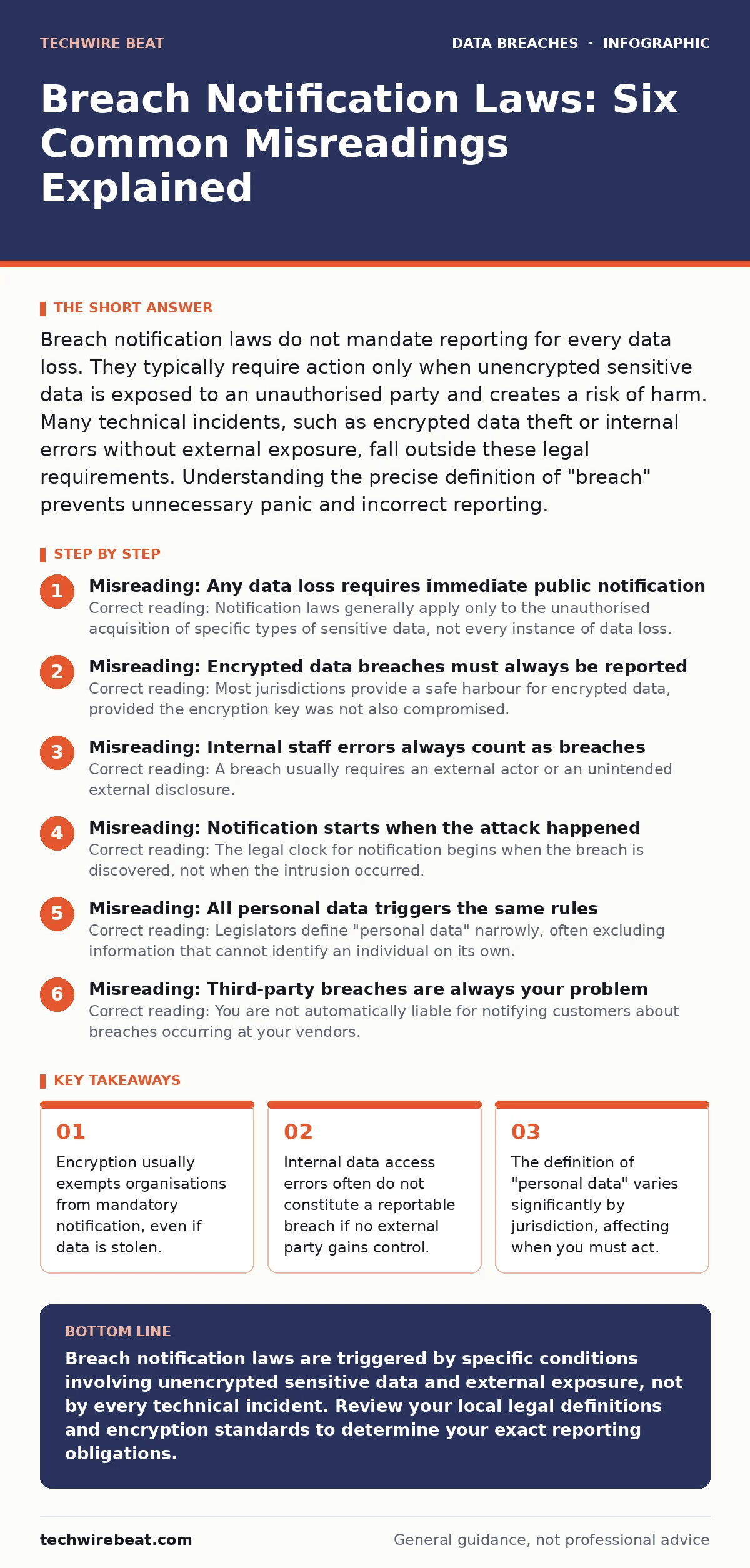
Misreading: Encrypted data breaches must always be reported
Correct reading: Most jurisdictions provide a safe harbour for encrypted data, provided the encryption key was not also compromised. If hackers steal a database where the records are encrypted at rest, they possess ciphertext, which is unreadable without the decryption key. The law assumes this state renders the data secure, even if it is in unauthorised hands. You must verify that your encryption standards meet the legal definition of "strong" encryption.
Weak or outdated algorithms may not qualify for this exemption. If the encryption key was stored alongside the data and was also stolen, the safe harbour disappears. In that scenario, the data is considered compromised, and notification becomes mandatory. This technical nuance is why encryption in transit and at rest are distinct security controls. One protects data moving across networks, while the other protects data sitting on disks. Both are necessary to maintain the legal exemption.
Misreading: Internal staff errors always count as breaches
Correct reading: A breach usually requires an external actor or an unintended external disclosure. If an employee accidentally deletes a file or sends an email to the wrong internal colleague, this is an operational error, not necessarily a legal breach. The key factor is whether the data left the organisation’s control. If the data remains within the trusted network perimeter, the risk of harm is considered managed internally.
You must assess whether the mistake resulted in unauthorised access by a third party. If the error was corrected before any external exposure occurred, notification is rarely required. This protects organisations from reporting every human mistake. It encourages a culture of fixing errors quickly rather than hiding them. However, if the internal error leads to data being emailed to a client or vendor, the chain of custody changes. At that point, you must evaluate if the recipient was authorised to hold that specific data.
Misreading: Notification starts when the attack happened
Correct reading: The legal clock for notification begins when the breach is discovered, not when the intrusion occurred. Attackers often dwell in systems for weeks or months before their presence is detected. You cannot report an event you do not know exists. The law recognises this reality by tying the deadline to the moment of reasonable discovery. You must document when your monitoring systems first flagged the anomaly. This timestamp becomes your reference point for calculating the notification window.
Waiting until you have full forensic clarity can cause you to miss the deadline. You should notify regulators as soon as you have enough evidence to confirm unauthorised access. You do not need to know the full scope or the attacker’s identity. This rule prevents bad actors from hiding in the shadows while you investigate. It forces organisations to maintain active monitoring capabilities. For more on keeping your systems visible, see our guide on vendor risk management.
Misreading: All personal data triggers the same rules
Correct reading: Legislators define "personal data" narrowly, often excluding information that cannot identify an individual on its own. An IP address, for example, may not be considered personal data in some jurisdictions unless combined with other identifiers. A list of product purchases without names or addresses is generally not reportable. You must map your data inventory against the specific definitions in your local law.
Some regions treat biometric data or health information as "sensitive," triggering stricter rules and shorter deadlines. Other data types may have longer windows or lower thresholds for reporting. Misclassifying data can lead to over-reporting or under-reporting. Over-reporting wastes resources and alerts attackers to your detection capabilities. Under-reporting exposes you to fines and loss of consumer trust. Understanding these distinctions is vital for accurate compliance. This is why customer data exposure assessments must be granular and precise.
See also: Video Conferencing Security: Benefits, Limits and When to Use It · End-to-End Encryption Explained: How Your Data Stays Private
Misreading: Third-party breaches are always your problem
Correct reading: You are not automatically liable for notifying customers about breaches occurring at your vendors. Your obligation depends on the contractual terms and the nature of the data sharing. If a cloud provider suffers an attack, they are typically responsible for notifying their own customers, which includes you. Your duty is to review their notification and determine if your own customers need direct contact. If the vendor fails to notify you, you may still have a duty to investigate.
You must assume your data is at risk until the vendor provides evidence of containment. This creates a dependency on your supplier’s security posture. You cannot outsource your legal responsibility entirely. This is why backup strategies must include verification of vendor security practices. If the vendor goes bankrupt or disappears, you must have a plan to inform your stakeholders. The law expects you to manage the risk in the supply chain.
Misreading: Risk of harm is purely a technical assessment
Correct reading: The legal threshold for notification often hinges on the "risk of harm" to individuals, which is a contextual judgment, not just a technical fact. Even if data is stolen, if it is old, incomplete, or unlikely to be used for fraud, you may argue that no significant harm is likely. Regulators look at the type of data, the number of people affected, and the potential for misuse. For instance, stolen passwords are high risk, while stolen public business addresses are low risk.
You must document your risk assessment process. This includes considering if the data was already public or if individuals have been notified of previous exposures. This step allows you to avoid unnecessary notifications for low-impact events. However, you must be prepared to defend your decision. If regulators disagree with your risk assessment, you face penalties. This is why tax identity theft prevention is a key consideration when financial data is involved. The potential for financial fraud elevates the risk profile significantly.
Misreading: One notification covers all jurisdictions
Correct reading: Data protection laws are not uniform across borders or even within countries. A breach affecting users in multiple states or nations may require separate notifications to each regulator. Each jurisdiction has its own deadline, format, and content requirements. You must identify where your data subjects reside, not just where your servers are located. This creates a complex compliance matrix for global organisations.
Failing to notify one regulator can result in fines in that specific region. You cannot assume that notifying your home regulator satisfies all obligations. This fragmentation increases the administrative burden significantly. It requires legal expertise in multiple jurisdictions. This is why medical identity theft concerns vary by region, with healthcare data often having stricter rules. You must tailor your response to each legal environment.
Misreading: Notification ends the legal obligation
Correct reading: Sending a notification letter does not absolve you of further duties. You must often provide follow-up information as the investigation progresses. Regulators may request additional details about the cause, scope, and remediation steps. You must also offer credit monitoring or other remediation services in some cases. This is not optional; it is part of the legal requirement to mitigate harm. Failing to provide these services can lead to further penalties.
You must maintain records of all communications with regulators and affected individuals. These records may be needed in future audits or litigation. The obligation continues until the incident is fully resolved and all regulatory questions are answered. This is why leaked source code incidents require ongoing monitoring, as new vulnerabilities may be discovered over time. You must stay engaged until the risk is fully neutralised.
Key takeaways
- Encryption usually exempts organisations from mandatory notification, even if data is stolen.
- Internal data access errors often do not constitute a reportable breach if no external party gains control.
- The definition of "personal data" varies significantly by jurisdiction, affecting when you must act.
- Risk of harm is a legal threshold, not just a technical vulnerability assessment.
Breach notification laws are triggered by specific conditions involving unencrypted sensitive data and external exposure, not by every technical incident. Review your local legal definitions and encryption standards to determine your exact reporting obligations.
Frequently asked questions
Do I need to notify users if only their email addresses were stolen?
Generally, no. Email addresses alone are often considered low-risk or public information. Check your local laws for specific exemptions regarding contact details.
What if I am unsure if the data was encrypted?
Assume it was not. The burden of proof is on you to demonstrate that strong encryption was in place and the keys were secure.
Can I delay notification to investigate further?
No. The clock starts at discovery. You must notify within the legal window, even if the full scope is unknown. You can provide updates later.
Does a near-miss count as a breach?
No. If unauthorised access was attempted but failed, no data was acquired. This is a security incident, not a reportable breach.
How this guide was produced: written by the TechWire Beat editorial team with AI assistance, checked against the public references listed below, and reviewed when the facts change. See our editorial policy or report an error.