Vendor Risk Mistakes That Expose Your Data and How to Fix Them
Most organisations fail vendor assessments by checking boxes instead of verifying how third-party systems actually handle sensitive information during routine operations.

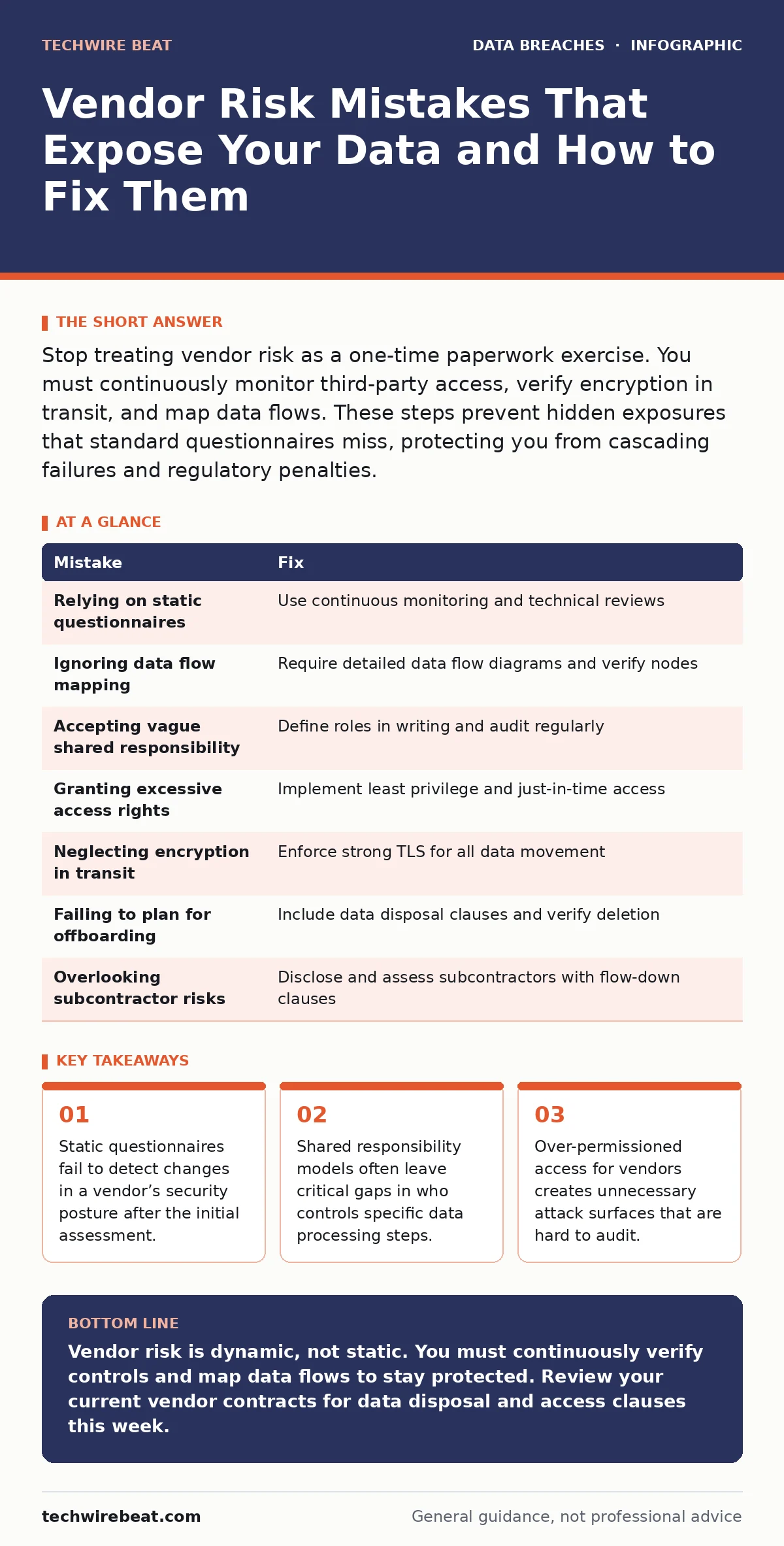
Stop treating vendor risk as a one-time paperwork exercise. You must continuously monitor third-party access, verify encryption in transit, and map data flows. These steps prevent hidden exposures that standard questionnaires miss, protecting you from cascading failures and regulatory penalties.
Mistake 1: Relying on Static Questionnaires
Most organisations begin vendor risk management by sending a security questionnaire. You expect the vendor to answer honestly about their controls. This creates a false sense of security because the answers reflect the vendor’s perception, not reality. The document becomes outdated the moment the vendor changes its infrastructure or personnel.
Why it hurts:
A questionnaire is a snapshot in time. It does not capture gradual degradation of security controls. Suppose a vendor updates its firewall rules to allow faster data transfer but inadvertently opens a port. Your questionnaire still says they are secure. You remain unaware until an incident occurs. This gap between documented policy and actual configuration is where most breaches originate.
The fix:
Replace static forms with continuous monitoring where possible. Use automated tools to verify that the vendor’s security certificates remain valid. Check that their domain’s security headers match their stated policies. If you cannot automate this, schedule quarterly technical reviews rather than annual paperwork. These reviews should include a technical interview, not just a form fill.
Mistake 2: Ignoring Data Flow Mapping
You often assume you know where your data goes once it leaves your network. You might believe it stays within the vendor’s primary data centre. In reality, data often passes through multiple subcontractors, cloud providers, and backup services. Each hop introduces a new potential point of failure. Without a clear map, you cannot assess the risk at each stage.
Why it hurts:
Unmapped data flows hide secondary risks. A vendor might store your primary data securely but use an unsecured third-party logging service for debugging. That logging service may retain sensitive fragments of your customer data. If that service suffers a data breach, you are liable for the exposure. You cannot protect what you cannot see. This lack of visibility prevents you from enforcing consistent security standards across the entire supply chain.
The fix:
Require vendors to provide a detailed data flow diagram. This diagram must show every system that touches your data, including backup and disaster recovery sites. Verify that each node in the diagram has appropriate encryption and access controls. If the vendor refuses to share this information, treat the relationship as high risk. You should also review your own internal data handling to ensure you are not creating unexpected leaks.
Mistake 3: Accepting Vague Shared Responsibility Models
Cloud services and SaaS platforms operate on a shared responsibility model. The vendor secures the infrastructure, while you secure your data and access. However, the boundary between these responsibilities is often blurred in contracts. You might assume the vendor encrypts data at rest, while they assume you handle key management. This ambiguity leaves critical gaps in your defence.
Why it hurts:
When responsibilities are unclear, both parties may assume the other is acting. Suppose you assume the vendor monitors for anomalous login attempts. They assume you configure multi-factor authentication for your users. If attackers exploit weak credentials, neither party detects the breach early. This delay allows attackers to exfiltrate more data. The consequence is not just data loss, but also the inability to assign blame during a breach notification.
The fix:
Define the shared responsibility model in writing before signing any contract. Specify exactly which party manages encryption keys, access logs, and incident response. Use standard frameworks to align expectations. Ensure your internal teams understand their specific duties. Regularly audit these responsibilities to ensure they are being met. This clarity reduces the risk of accidental exposure due to assumption errors.
Mistake 4: Granting Excessive Access Rights
Convenience often overrides security in vendor onboarding. You grant vendors broad access to your systems to speed up integration. This might include read-write access to entire databases or administrative privileges to cloud consoles. While this speeds up initial setup, it creates a massive attack surface. Each additional permission is a potential entry point for attackers.
Why it hurts:
Excessive access violates the principle of least privilege. If a vendor’s account is compromised, attackers gain immediate access to all the permissions you granted. They can move laterally within your network, access unrelated data, or install malware. You lose the ability to isolate the breach. This makes containment difficult and increases the severity of the incident. The risk grows with the number of vendors you engage.
The fix:
Implement strict access controls for all vendor accounts. Grant only the minimum permissions required for the specific task. Use just-in-time access, where privileges are granted temporarily and revoked automatically. Monitor vendor activity logs for unusual behaviour. Regularly review and revoke access that is no longer needed. This limits the blast radius of any potential compromise.
Mistake 5: Neglecting Encryption in Transit
You often focus on encrypting data at rest, ignoring how it moves. Data travels between your systems and the vendor’s servers over the internet. If this transit is not encrypted, it is vulnerable to interception. Attackers can capture sensitive information as it moves through network nodes. This is particularly risky when using public networks or unsecured APIs.
Why it hurts:
Unencrypted transit exposes data to man-in-the-middle attacks. Attackers can intercept credentials, personal information, or proprietary data. Even if the end points are secure, the journey is not. This undermines the entire security posture. You may comply with data protection laws for storage but fail to protect data in motion. This creates a legal and reputational risk that is often overlooked.
The fix:
Enforce strong encryption for all data in transit. Use standard protocols like TLS 1.2 or higher. Disable older, weaker protocols that are vulnerable to known attacks. Verify that the vendor uses the same standards. Check certificate validity and domain matching. This ensures that data remains confidential and intact during transmission. It is a simple but often neglected control.
See also: How SQL Injection Works: The Step-by-Step Attack Lifecycle
Mistake 6: Failing to Plan for Offboarding
You focus heavily on onboarding vendors but neglect the end of the relationship. When a contract expires or a service is discontinued, data often remains on the vendor’s systems. Access rights may not be revoked promptly. This lingering data is a significant risk. It can be accessed by former employees or used in future breaches. You lose control over information that should have been returned or destroyed.
Why it hurts:
Orphaned data is invisible to your security teams. You cannot monitor or protect what you do not know exists. If the vendor suffers a breach, your old data may be included. You have no legal right to demand its deletion if the contract was unclear. This leaves you vulnerable to long-tail risks. The cost of cleaning up after a vendor departure can exceed the cost of proper offboarding.
The fix:
Include clear data disposal clauses in your contracts. Specify the method and timeline for data destruction. Verify that the vendor has deleted the data and removed access rights. Obtain a certificate of destruction. Archive these records for audit purposes. This ensures a clean break and reduces residual risk. It is a critical step often missed in the rush to end a relationship.
Mistake 7: Overlooking Subcontractor Risks
Vendors often use subcontractors to provide parts of their service. You might assess the primary vendor but ignore their supply chain. These subcontractors may have weaker security controls. They handle your data but are not directly accountable to you. This creates a blind spot in your risk management.
Why it hurts:
A breach at a subcontractor level can expose your data just as effectively as a breach at the primary vendor. You have no direct contract with the subcontractor, so you cannot enforce security standards. The primary vendor may not fully disclose their subcontractors. This lack of transparency makes it impossible to assess the true risk. You are relying on the vendor’s honesty and competence to manage their own supply chain.
The fix:
Require vendors to disclose all subcontractors that handle your data. Assess their security posture as part of your vendor review. Include flow-down clauses in contracts that require subcontractors to meet your security standards. Regularly review the vendor’s subcontractor list for changes. This extends your visibility and control deeper into the supply chain.
| Mistake | Fix |
|---|---|
| Relying on static questionnaires | Use continuous monitoring and technical reviews |
| Ignoring data flow mapping | Require detailed data flow diagrams and verify nodes |
| Accepting vague shared responsibility | Define roles in writing and audit regularly |
| Granting excessive access rights | Implement least privilege and just-in-time access |
| Neglecting encryption in transit | Enforce strong TLS for all data movement |
| Failing to plan for offboarding | Include data disposal clauses and verify deletion |
| Overlooking subcontractor risks | Disclose and assess subcontractors with flow-down clauses |
Key takeaways
- Static questionnaires fail to detect changes in a vendor’s security posture after the initial assessment.
- Shared responsibility models often leave critical gaps in who controls specific data processing steps.
- Over-permissioned access for vendors creates unnecessary attack surfaces that are hard to audit.
Vendor risk is dynamic, not static. You must continuously verify controls and map data flows to stay protected. Review your current vendor contracts for data disposal and access clauses this week.
Frequently asked questions
How often should I re-assess my vendors?
You should re-assess vendors at least annually, or whenever they change their infrastructure or service offerings significantly.
Do I need to audit every small vendor?
No. Focus your efforts on vendors that handle sensitive data or have deep access to your systems. Use a risk-based approach.
What if a vendor refuses to share security details?
Treat them as high risk. Consider finding an alternative vendor who is transparent about their security practices.
How do I handle encrypted data backups?
Ensure you control the encryption keys for backups. The vendor should only handle the encrypted blobs, not the keys to decrypt them.
How this guide was produced: written by the TechWire Beat editorial team with AI assistance, checked against the public references listed below, and reviewed when the facts change. See our editorial policy or report an error.