Secrets management best practices for secure infrastructure
Storing credentials in environment variables exposes them to every process on the host, creating a hidden attack vector that standard scanning tools often miss.

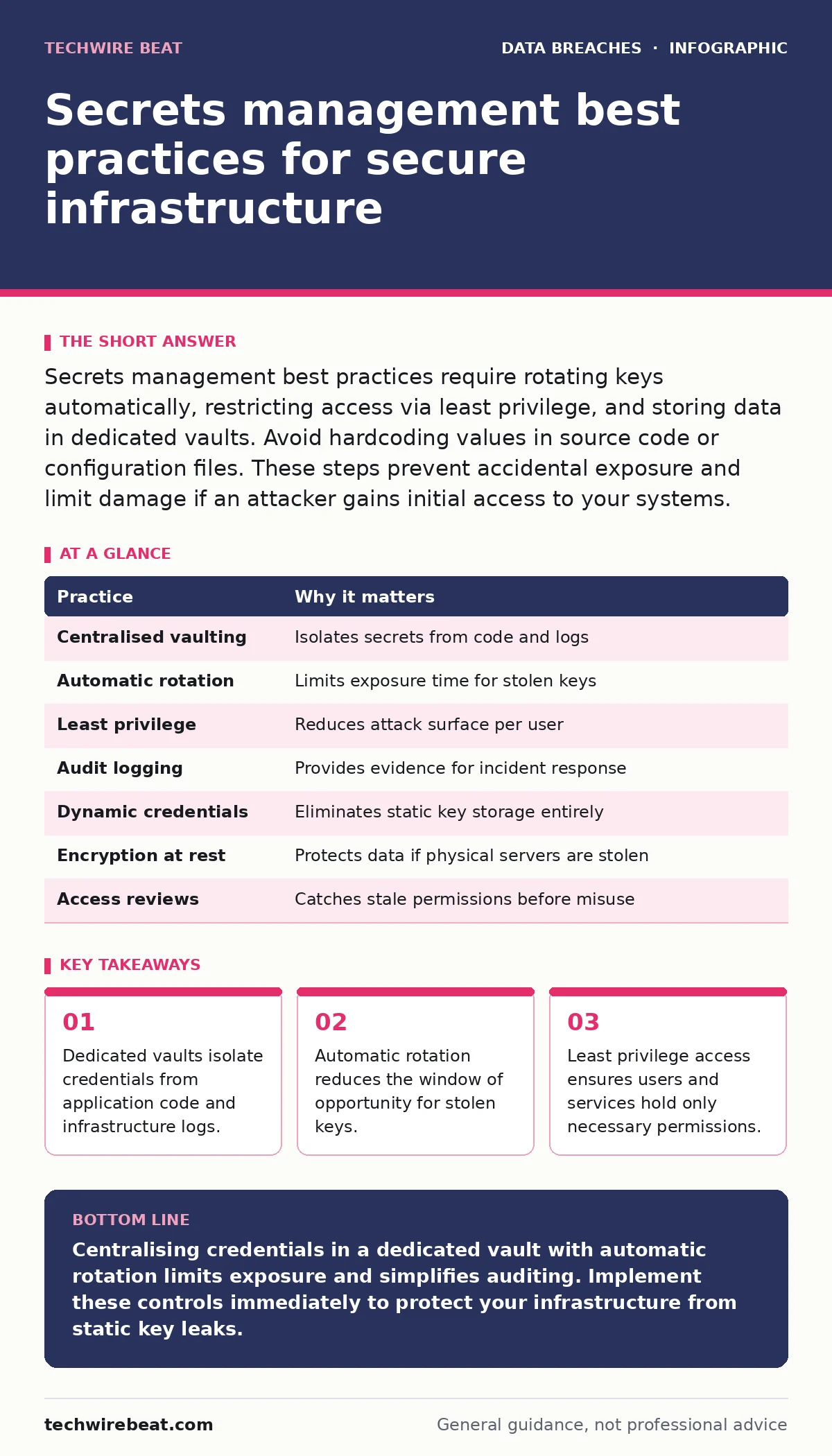
Secrets management best practices require rotating keys automatically, restricting access via least privilege, and storing data in dedicated vaults. Avoid hardcoding values in source code or configuration files. These steps prevent accidental exposure and limit damage if an attacker gains initial access to your systems.
Secrets management best practices defined
Secrets management best practices focus on how you store, access, and rotate sensitive data. You handle passwords, API keys, and encryption tokens through dedicated systems. This approach separates credentials from the code that uses them. Hardcoding values creates permanent risks that survive deployment. You need a strategy that adapts when personnel change or systems evolve. Proper management prevents accidental leaks in public repositories. It also limits the damage if a server is compromised.
| Practice | Why it matters |
|---|---|
| Centralised vaulting | Isolates secrets from code and logs |
| Automatic rotation | Limits exposure time for stolen keys |
| Least privilege | Reduces attack surface per user |
| Audit logging | Provides evidence for incident response |
| Dynamic credentials | Eliminates static key storage entirely |
| Encryption at rest | Protects data if physical servers are stolen |
| Access reviews | Catches stale permissions before misuse |
1. Use a dedicated secrets vault
You store credentials in a specialised database designed for security. This vault encrypts data at rest and controls access strictly. General configuration files lack these protections. They often appear in version control history. A dedicated system provides a single point of truth. It also offers auditing capabilities that flat files cannot. You centralise control to reduce administrative overhead. This structure prevents fragmentation across multiple teams.
2. Implement automatic key rotation
You change credentials on a schedule without manual intervention. Static keys remain valid indefinitely if stolen. Automatic rotation limits the value of a compromised secret. You configure your vault to issue new keys periodically. Applications must request fresh credentials at startup. This process requires integration between your code and the vault. It adds complexity but significantly reduces risk. You eliminate the human error of forgotten updates.
3. Enforce least privilege access
You grant permissions only for specific tasks and durations. Broad access rights increase the impact of a breach. You define roles that match job functions precisely. A developer needs read access to configuration, not write access to production keys. You review these permissions regularly. Over time, roles expand beyond initial needs. Regular audits catch these drifts. You restrict access to prevent internal misuse and external exploitation.
4. Enable comprehensive audit logging
You record every access attempt to sensitive data. Logs provide visibility into who accessed what and when. Without logs, you cannot detect unusual behaviour. You store these logs in a separate, immutable system. Attackers often delete local logs to cover their tracks. Centralised logging preserves evidence for investigation. You monitor for anomalies like access outside working hours. This visibility supports compliance and incident response efforts.
See also: Credential Dumps Explained: How Stolen Passwords Work · Insider Data Theft Prevention Checklist for Secure Operations
5. Prefer dynamic credentials over static keys
You generate temporary tokens instead of long-lived passwords. Dynamic credentials expire after a short period. They are unique to each session. This method eliminates the need to store permanent secrets. You integrate your applications with identity providers. The provider issues short-lived tokens on demand. This approach reduces the attack surface significantly. You avoid the risk of static keys being leaked in logs.
6. Encrypt data at rest and in transit
You protect secrets using strong encryption algorithms. Encryption at rest secures data on disk. Encryption in transit protects data moving between services. You manage encryption keys separately from the encrypted data. This separation adds a layer of defence. Even if an attacker accesses the storage, they cannot read the content. You use standard protocols for transport security. You verify certificate validity during connections.
7. Conduct regular access reviews
You evaluate permissions quarterly or after role changes. Stale access rights accumulate over time. Former employees may retain access to critical systems. You automate the review process where possible. You require managers to approve continued access. This step ensures accountability. You remove unnecessary permissions promptly. Regular reviews prevent privilege creep. They align access with current operational needs.
Integrating with broader security strategies
Secrets management does not exist in isolation. You align it with other security controls. For example, proper backup strategies include encrypted copies of vault configurations. You ensure that recovery processes do not expose credentials. You also consider the impact of leaked source code on your secret rotation policies. If code is exposed, you assume all embedded keys are compromised. You rotate them immediately. This proactive stance mitigates the risk of credential dumps. You treat secrets as high-value targets.
Handling edge cases and exceptions
Some legacy systems cannot connect to modern vaults. You must find workarounds for these constraints. You might use proxy services that mask the underlying complexity. You isolate these systems on separate networks. You monitor them more closely. You plan for eventual migration. You document these exceptions clearly. You review them regularly to ensure they remain secure. You avoid creating permanent exceptions that bypass security controls.
Conclusion on operational resilience
You build a system that withstands change. Personnel turnover and technology shifts are inevitable. Your secrets management strategy must adapt. You automate as much as possible. You reduce reliance on individual knowledge. You document processes for new team members. You test your recovery procedures regularly. You ensure that your team can restore access in an emergency. This resilience protects your organisation from internal and external threats. You maintain control over your most sensitive assets.
Key takeaways
- Dedicated vaults isolate credentials from application code and infrastructure logs.
- Automatic rotation reduces the window of opportunity for stolen keys.
- Least privilege access ensures users and services hold only necessary permissions.
Centralising credentials in a dedicated vault with automatic rotation limits exposure and simplifies auditing. Implement these controls immediately to protect your infrastructure from static key leaks.
Frequently asked questions
How often should I rotate API keys?
Rotate keys every 90 days or immediately if you suspect compromise. Automate this process to ensure consistency and reduce administrative burden.
Can I use password managers for server credentials?
Personal password managers lack the audit trails and integration capabilities required for server infrastructure. Use dedicated enterprise vaults instead.
What happens if I lose access to my vault?
You must maintain offline recovery keys or break-glass procedures. Test these procedures regularly to ensure you can restore access during an emergency.
Does encryption replace the need for secrets management?
Encryption protects data but does not control access. You still need a system to manage who can decrypt and use the secrets securely.
How this guide was produced: written by the TechWire Beat editorial team with AI assistance, checked against the public references listed below, and reviewed when the facts change. See our editorial policy or report an error.