How Cryptomining Attacks on Exposed Servers Work: A Step-by-Step Breakdown
Attackers harvest exposed servers for computing power by exploiting misconfigured access controls, turning your infrastructure into a silent money-making machine without stealing data.

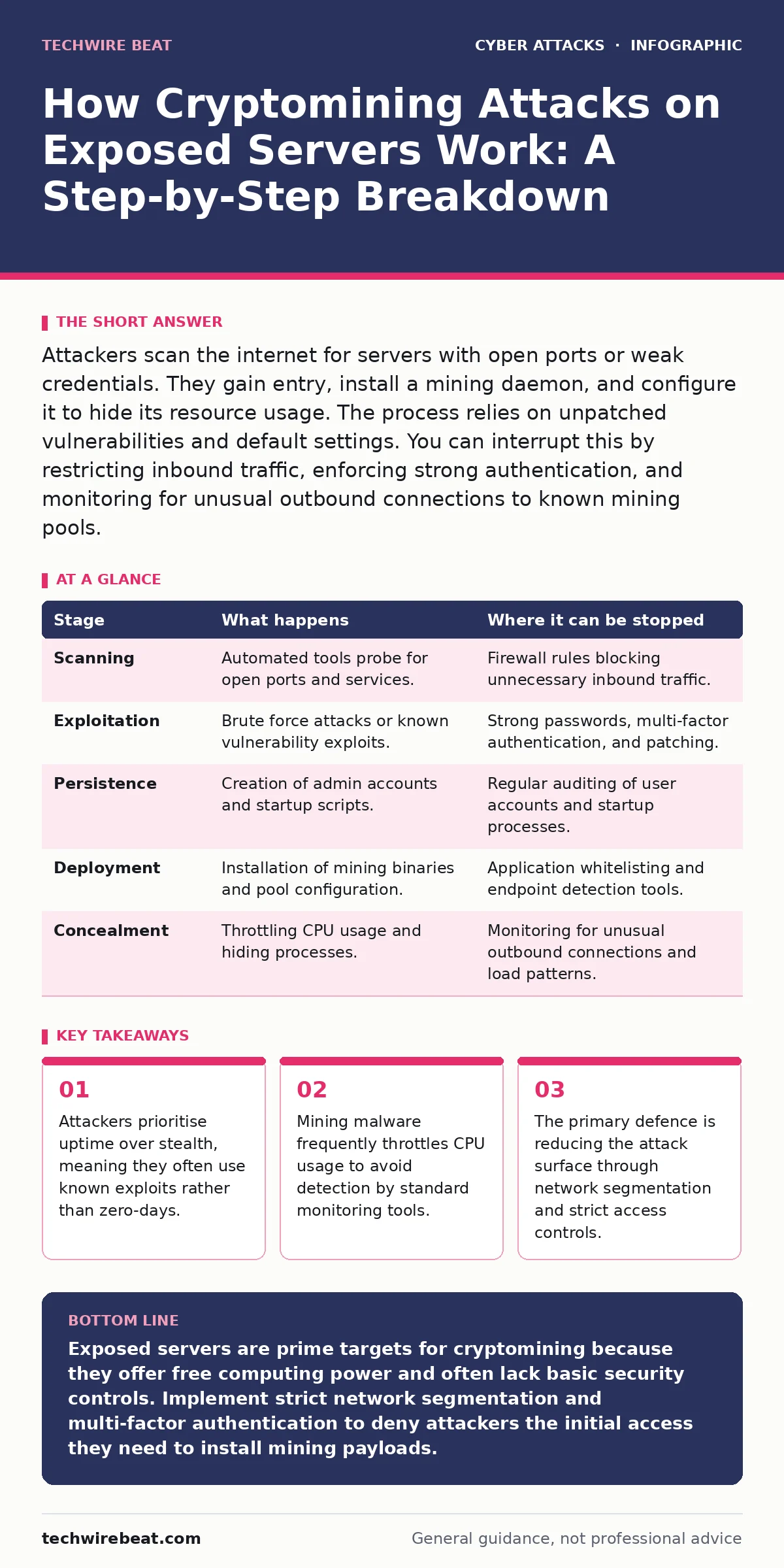
Attackers scan the internet for servers with open ports or weak credentials. They gain entry, install a mining daemon, and configure it to hide its resource usage. The process relies on unpatched vulnerabilities and default settings. You can interrupt this by restricting inbound traffic, enforcing strong authentication, and monitoring for unusual outbound connections to known mining pools.
The Initial Scan for Vulnerable Targets
Attackers begin by mapping the internet to find exposed servers. They use automated scanners that probe millions of IP addresses for open ports and running services. The scanner looks for common entry points such as SSH on port 22, remote desktop on port 3389, or database ports like 3306. If a service responds, the scanner records the IP address and the version of the software running. This phase is purely passive for the victim. No data is stolen yet. The attacker simply builds a list of potential targets. The success of this stage depends entirely on how many services you expose to the public internet. Every open port is a door they can try to kick open.
Exploiting Weak Access Controls
Once a target is identified, the attacker attempts to gain entry. They rely on two main weaknesses: default credentials and unpatched software. Many administrators leave default usernames and passwords unchanged on new installations. Automated tools try common combinations like "admin/admin" or "root/password" at high speed. If brute force fails, the attacker shifts to known vulnerabilities.
They look for software versions with public exploits. This mirrors the mechanics found in general guides on attack vectors, where the path of least resistance is always chosen. The attacker does not need to be clever. They need a working exploit and a server that has not been updated. This stage exploits human error and neglect.
Establishing Initial Access and Persistence
After gaining entry, the attacker ensures they can return. They create a new user account with administrative privileges. This account often has a generic name to blend in with system logs. The attacker then modifies startup scripts or cron jobs to ensure their tools run after a reboot. This is called persistence. Without it, a server restart would kick them out. They may also install rootkits to hide their processes from standard system commands. The goal is to make their presence invisible to routine checks. This step is critical because it transforms a one-time intrusion into a long-term foothold. The server becomes a reliable asset for their operations.
Deploying the Cryptomining Payload
The attacker now installs the mining software. This is often a compiled binary that does not require additional libraries. They configure the software to connect to a mining pool. The pool aggregates computing power from many compromised servers to solve cryptographic puzzles. The rewards are distributed among participants. The attacker uses their own wallet address to receive the funds. They may also install a command-and-control channel. This allows them to send remote instructions to the server. They can change the mining algorithm, pause the activity, or update the malware. The payload is designed to be lightweight and modular. It adapts to the resources available on the server.
Hiding Resource Consumption
Mining consumes significant computing power and electricity. If the usage spikes, the server owner will notice. To avoid detection, the malware includes throttling mechanisms. It monitors system load and reduces its activity when other processes are running. This keeps the server responsive to legitimate users. The malware may also run only during off-peak hours. This stealth tactic allows the attack to persist for months. The server appears normal during the day but mines at night. This is a common trait in cybercrime-as-a-service offerings, where stability and longevity are more valuable than maximum output. The attacker sacrifices profit for persistence.
| Stage | What happens | Where it can be stopped |
|---|---|---|
| Scanning | Automated tools probe for open ports and services. | Firewall rules blocking unnecessary inbound traffic. |
| Exploitation | Brute force attacks or known vulnerability exploits. | Strong passwords, multi-factor authentication, and patching. |
| Persistence | Creation of admin accounts and startup scripts. | Regular auditing of user accounts and startup processes. |
| Deployment | Installation of mining binaries and pool configuration. | Application whitelisting and endpoint detection tools. |
| Concealment | Throttling CPU usage and hiding processes. | Monitoring for unusual outbound connections and load patterns. |
See also: Browser in the Browser Attacks: How Fake Logins Steal Credentials · Browser-in-the-Browser Attacks: 6 Myths That Keep You Vulnerable
The Financial Extraction Loop
The mining software sends computing power to the pool. The pool confirms the work and adds it to the blockchain. When a block is found, the reward is split. The attacker collects a small fraction of cryptocurrency. This process repeats continuously. The attacker monitors the profitability of their fleet. If a server becomes too hot or slow, they may drop it and move to the next. The financial gain is passive but steady. It relies on the victim not noticing the increased electricity bill or the slight performance degradation. The attacker does not care about the data on the server. They only care about the processing power. This makes the threat distinct from data theft.
Disruption and Recovery Challenges
When the attack is discovered, stopping it is not enough. The attacker has likely installed multiple backdoors. Removing the mining software leaves the persistence mechanisms in place. The attacker can simply reinstall the payload. A full recovery requires identifying all modified files, accounts, and configurations. This often means wiping the server and rebuilding it from a known good state.
Backups may be compromised if the attacker had access for a long time. The disruption extends beyond the technical fix. Downtime affects services and revenue. The hidden cost is the loss of trust and the time spent investigating the breach. This scenario highlights the importance of account lockout policies to prevent initial brute-force success.
Structural Weaknesses in Server Security
The success of these attacks relies on specific structural failures. The first is the exposure of management interfaces to the public internet. Administrative ports should never be accessible from outside the corporate network. The second is the lack of network segmentation. If one server is compromised, the attacker can move laterally to others. This amplifies the damage. The third is the absence of baseline monitoring. Without knowing what normal traffic looks like, anomalous outbound connections to mining pools go unnoticed. These weaknesses are often overlooked in favour of convenience. Security is treated as an afterthought rather than a design principle.
Mitigation Through Layered Defences
Protecting against cryptomining requires a layered approach. Start with network segmentation. Isolate servers that do not need public access. Use firewalls to block all inbound traffic except what is strictly necessary. Apply the principle of least privilege. Users and services should have only the permissions they need. This limits the damage if an account is compromised. Keep all software updated. Patches close the vulnerabilities that attackers scan for. Implement multi-factor authentication. This stops brute-force attacks even if passwords are weak. These measures are similar to those recommended for hardware security keys, which add a physical layer of verification.
Monitoring for Anomalous Behaviour
Detection relies on monitoring for unusual patterns. Look for outbound connections to known mining pool domains. These domains change frequently, so use threat intelligence feeds. Monitor CPU and GPU usage for sustained high loads during off-peak hours. Check for new user accounts created recently. Audit startup scripts for unknown entries. Implement logging that captures process creation and network connections. Analyse this data for deviations from the baseline. The key is consistency. Normal servers have predictable patterns. Deviations indicate compromise. This proactive monitoring is the last line of defence before financial loss occurs. It requires dedicated tools and expertise.
The Role of Authentication Strength
Weak authentication is the primary entry point for these attacks. Default credentials are the easiest target. Complex passwords are better, but they can still be stolen or guessed. Multi-factor authentication adds a significant barrier. It requires something the user knows and something they have. This makes remote brute-force attacks nearly impossible.
Even if the attacker has the password, they cannot log in without the second factor. This is where passkeys offer a modern solution, eliminating password-based vulnerabilities entirely. Strong authentication protects the door. Without it, all other defences are compromised. Prioritise authentication hardening in your security strategy.
Long-Term Security Hygiene
Security is not a one-time task. It requires continuous effort. Regularly review access logs and system configurations. Update software promptly. Train staff to recognise social engineering attempts. Test your incident response plans. Assume that attackers will find a way in. The goal is to detect them quickly and limit the damage. This mindset shifts security from prevention to resilience. It acknowledges that breaches will happen. The question is how well you can respond. This approach aligns with the broader strategy for defending against attacks on data centers, where scale and speed are critical. Stay vigilant and adapt to new threats.
Key takeaways
- Attackers prioritise uptime over stealth, meaning they often use known exploits rather than zero-days.
- Mining malware frequently throttles CPU usage to avoid detection by standard monitoring tools.
- The primary defence is reducing the attack surface through network segmentation and strict access controls.
Exposed servers are prime targets for cryptomining because they offer free computing power and often lack basic security controls. Implement strict network segmentation and multi-factor authentication to deny attackers the initial access they need to install mining payloads.
Frequently asked questions
Can cryptomining malware steal my data?
Cryptomining malware is designed to use computing resources, not to exfiltrate data. However, the presence of such malware indicates a breach that could allow attackers to install additional tools capable of data theft.
How do I know if my server is being used for mining?
Look for sustained high CPU or GPU usage, especially during off-peak hours. Check for unknown outbound connections to cryptocurrency mining pools and audit user accounts for unauthorized additions.
Is blocking port 3389 enough to stop these attacks?
Blocking common ports helps, but attackers target any exposed service. You must also secure SSH, database ports, and web applications. Comprehensive network segmentation and strict firewall rules are required.
Why do attackers target small servers?
Small servers are often poorly secured and easier to compromise. Attackers aggregate many small servers to create a large mining operation, spreading risk and avoiding detection on any single high-profile target.
How this guide was produced: written by the TechWire Beat editorial team with AI assistance, checked against the public references listed below, and reviewed when the facts change. See our editorial policy or report an error.