Cybercrime-as-a-Service Explained: How Modular Malware Works
Criminals now sell modular attack components like software subscriptions, allowing unskilled users to launch sophisticated breaches without writing code.

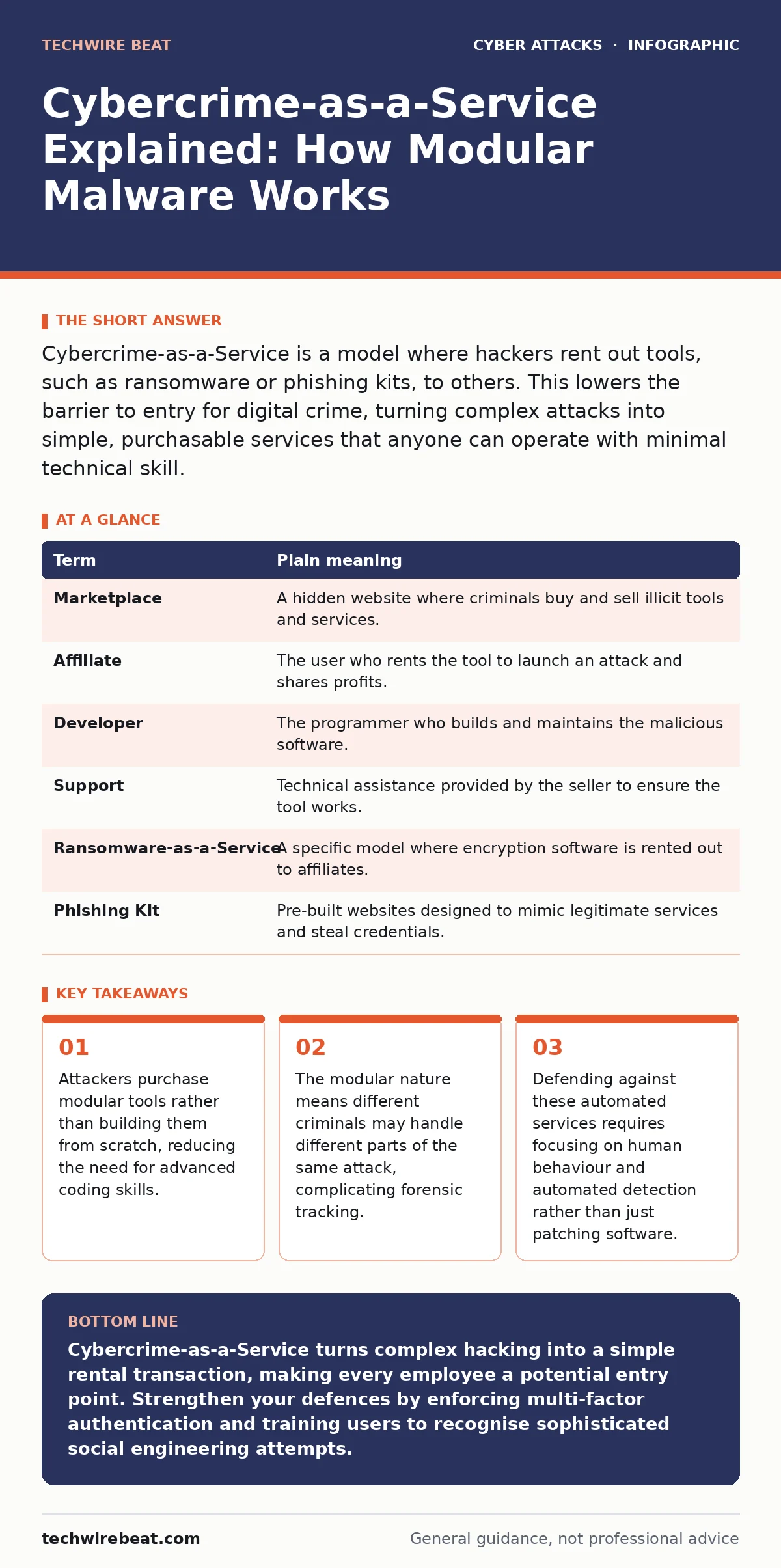
Cybercrime-as-a-Service is a model where hackers rent out tools, such as ransomware or phishing kits, to others. This lowers the barrier to entry for digital crime, turning complex attacks into simple, purchasable services that anyone can operate with minimal technical skill.
The Digital Takeaway Menu
Imagine you want to open a restaurant but lack culinary skills. Instead of learning to cook, you buy a ready-made meal kit. You provide the location and customers, while a supplier provides the ingredients and instructions. You simply assemble and serve.
Cybercrime-as-a-Service operates on this same principle. The supplier provides the malicious software and technical infrastructure. You provide the target list and the initial contact. The complexity of the attack is hidden behind a user-friendly interface, much like a takeaway menu.
This model has democratised digital crime. You no longer need to understand network protocols or exploit vulnerabilities. You only need to know how to navigate a website and transfer funds. The technical heavy lifting is abstracted away, leaving you with a simple operational role.
Key Terms in the Underground Economy
To understand this ecosystem, you must separate the tool from the user. The person selling the malware is not the same as the person deploying it. This separation creates layers of anonymity and specialised roles.
| Term | Plain meaning |
|---|---|
| Marketplace | A hidden website where criminals buy and sell illicit tools and services. |
| Affiliate | The user who rents the tool to launch an attack and shares profits. |
| Developer | The programmer who builds and maintains the malicious software. |
| Support | Technical assistance provided by the seller to ensure the tool works. |
| Ransomware-as-a-Service | A specific model where encryption software is rented out to affiliates. |
| Phishing Kit | Pre-built websites designed to mimic legitimate services and steal credentials. |
Common Points of Confusion
Many readers assume that cybercrime requires a lone genius in a dark room. This is a myth. The reality is a collaborative industry with customer support and refund policies.
Another confusion is the belief that buying the tool means owning the code. Usually, you are renting access. The developer retains control of the central command server. If you try to modify the tool or cheat the developer, they can remotely disable your access.
You might also think that because the tool is sold openly, it is poorly made. On the contrary, commercial pressure drives quality. Developers compete on reliability and stealth. A buggy tool gets bad reviews, leading to lost business. This market force results in highly polished, difficult-to-detect malware.
The Hidden Cost of Modularity
The modularity of these services creates a hidden cost for defenders. When an attack fails, it is often due to user error, not software failure. The affiliate may have misconfigured the phishing page or targeted the wrong email format.
This means that blocking a specific piece of malware is rarely enough. The next affiliate will simply rent the same tool or a similar one. The underlying vulnerability in the victim's process remains open.
Furthermore, the separation of roles makes attribution difficult. The developer may be in one country, the affiliate in another, and the payment processor in a third. Law enforcement struggles to follow the money trail when each participant only holds a fragment of the puzzle.
Why Traditional Defences Struggle
Traditional security focuses on perimeter defence. It assumes the attacker is outside trying to get in. Cybercrime-as-a-Service changes this dynamic by targeting the human element directly.
Phishing kits are designed to bypass technical filters by mimicking trusted brands perfectly. They exploit trust, not software bugs. No firewall can stop an employee from voluntarily entering their credentials on a convincing fake login page.
This is why security awareness training remains a primary defence. You must train users to spot the subtle inconsistencies in URLs and sender addresses. Technical controls alone cannot detect social engineering.
Adapting Your Security Posture
To counter these services, you must reduce the value of stolen credentials. If a password is stolen, it should not grant immediate access to sensitive systems.
Implementing multi-factor authentication adds a layer of verification that phished passwords cannot bypass alone. Even if the affiliate gains your password, they cannot log in without the second factor.
Consider using hardware security keys for critical accounts. These physical devices are resistant to phishing because they cryptographically bind the authentication to the specific website domain. A fake site cannot trigger the key.
Try This Now
- Audit your critical accounts to ensure multi-factor authentication is enabled. Disable SMS-based verification where possible, as it is vulnerable to SIM swapping attacks.
- Review your organisation's account lockout policies. Ensure they balance security with usability to prevent denial-of-service attacks while stopping brute-force attempts.
- Conduct a simple test by sending a simulated phishing email to a small group. Measure the click-through rate to identify gaps in your security awareness training.
The Evolution of Threats
As defenders adapt, attackers evolve. They are moving beyond simple credential theft. New services offer remote access tools that allow affiliates to operate inside a network undetected for weeks.
This shift towards persistence means that detection becomes harder. The attack is no longer a single event but a prolonged campaign. You must assume that some level of access may already exist.
This is where zero trust security principles become relevant. By verifying every request as if it originates from an untrusted network, you limit the damage an affiliate can do even after gaining initial access.
Key takeaways
- Attackers purchase modular tools rather than building them from scratch, reducing the need for advanced coding skills.
- The modular nature means different criminals may handle different parts of the same attack, complicating forensic tracking.
- Defending against these automated services requires focusing on human behaviour and automated detection rather than just patching software.
Cybercrime-as-a-Service turns complex hacking into a simple rental transaction, making every employee a potential entry point. Strengthen your defences by enforcing multi-factor authentication and training users to recognise sophisticated social engineering attempts.
Frequently asked questions
Is cybercrime-as-a-service legal to use for ethical hacking?
No, using these tools without explicit written permission from the system owner is illegal, regardless of intent. Ethical hackers use legitimate, open-source tools and follow strict legal frameworks.
Can antivirus software detect cybercrime-as-a-Service tools?
Antivirus can detect known signatures, but these tools often use obfuscation to avoid detection. Behavioural analysis and endpoint detection are more effective against novel or modified malware.
How do attackers get paid for these services?
They typically use cryptocurrencies or prepaid gift cards to maintain anonymity. Some platforms also accept traditional bank transfers through mule accounts, which are harder to trace.
What is the difference between a marketplace and a forum?
Marketplaces are structured like e-commerce sites with listings and reviews. Forums are discussion boards where criminals share knowledge and occasionally trade tools in private messages.
How this guide was produced: written by the TechWire Beat editorial team with AI assistance, checked against the public references listed below, and reviewed when the facts change. See our editorial policy or report an error.