Spoofing vs Phishing: The Critical Difference You Must Know
Spoofing is the disguise of identity, while phishing is the act of theft; one provides the mask, the other performs the robbery.

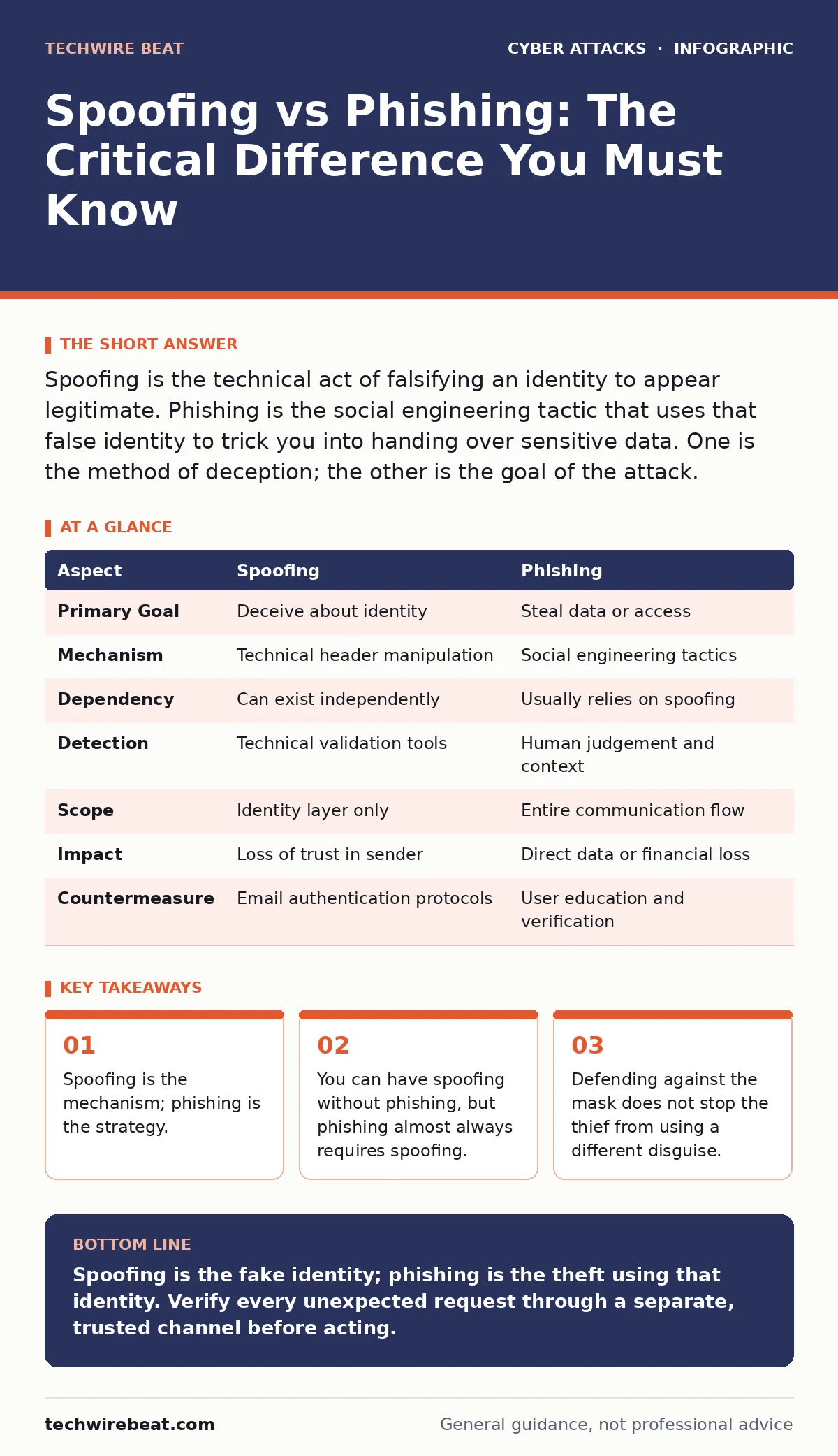
Spoofing is the technical act of falsifying an identity to appear legitimate. Phishing is the social engineering tactic that uses that false identity to trick you into handing over sensitive data. One is the method of deception; the other is the goal of the attack.
The Core Distinction
Imagine receiving an email that looks exactly like it came from your bank. The sender address is fake. This is spoofing. The email asks you to click a link and enter your password. This is phishing. Spoofing is the technical act of falsifying an identity to appear legitimate. It creates the illusion of trust. Phishing is the social engineering tactic that exploits that illusion to steal credentials or install malware. One is the method of deception; the other is the goal of the attack.
How Spoofing Works
Spoofing manipulates the headers or metadata of a communication to hide the true source. In email spoofing, attackers alter the "From" field so the message appears to originate from a trusted domain. This does not require breaking into that domain. It simply bypasses basic validation checks.
Voice spoofing, often used in vishing, uses software to mimic the frequency and tone of a known voice. This allows an attacker to sound like your IT support manager. The technology replicates audio characteristics, not the person’s intent. The recipient hears a familiar voice and lowers their guard, assuming the request is authorised.
How Phishing Works
Phishing relies on human psychology rather than technical exploits. It creates a sense of urgency, fear, or curiosity to bypass rational thought. The attacker wants you to take a specific action: click a link, open an attachment, or transfer funds.
The success of phishing depends on the quality of the pretext. A poorly written message raises suspicion. A well-crafted message mirrors the style and urgency of legitimate business communications. The attacker does not need to hack your system directly. They need you to hand them the keys voluntarily. This makes security awareness training a primary defence, as it teaches users to spot the psychological hooks.
Point-by-Point Comparison
| Aspect | Spoofing | Phishing |
|---|---|---|
| Primary Goal | Deceive about identity | Steal data or access |
| Mechanism | Technical header manipulation | Social engineering tactics |
| Dependency | Can exist independently | Usually relies on spoofing |
| Detection | Technical validation tools | Human judgement and context |
| Scope | Identity layer only | Entire communication flow |
| Impact | Loss of trust in sender | Direct data or financial loss |
| Countermeasure | Email authentication protocols | User education and verification |
Where They Overlap
Most successful phishing campaigns use spoofing as a foundational step. The attacker spoofs the sender address to gain initial credibility. Without this disguise, the phishing attempt would likely be ignored or deleted immediately. The overlap creates a layered attack where technical deception enables psychological manipulation.
However, the reverse is not true. An attacker can spoof an IP address to hide their location during a network scan. This is spoofing, but it is not phishing because there is no attempt to trick a user into action. The distinction matters for defence. If you only train users to spot phishing, you miss the technical indicators of spoofing. If you only block spoofed emails, you miss the phishing messages that bypass filters.
See also: What does tailgating mean: how to stop physical security breaches · Browser in the Browser Attacks: How Fake Logins Steal Credentials
Choosing Your Defence
Choose to focus on anti-spoofing measures when:
- You need to protect the integrity of your domain reputation.
- You want to prevent attackers from using your brand to target others.
- You are implementing technical controls like multi-factor authentication to add a layer that spoofing cannot bypass.
Choose to focus on anti-phishing measures when:
- Your workforce handles sensitive data or financial transactions.
- You operate in an industry targeted by social engineering.
- You need to reduce the human error factor in security incidents.
The Hidden Cost of Confusion
Many organisations treat these as the same issue. This leads to incomplete defences. You might install advanced email filters that catch spoofed headers but fail to stop a phishing email that uses a legitimate, compromised account. Conversely, you might train staff to spot fake URLs but leave your domain open to being used in spoofing attacks by criminals using cybercrime-as-a-service platforms.
The hidden cost is a false sense of security. Blocking spoofed emails gives the impression that your inbox is safe. It is not. Attackers adapt. They use legitimate accounts, bypassing spoofing checks entirely. They then use phishing tactics to steal credentials from those accounts.
Practical Mitigation Strategies
Technical controls stop the easy attacks. Implementing standards like SPF, DKIM, and DMARC validates email sources. These protocols make it harder to spoof your domain. They do not stop an attacker from spoofing a different domain that looks similar.
Human controls stop the clever attacks. Security awareness training helps users recognise the subtle signs of phishing. This includes checking for urgency, unexpected attachments, and slight mismatches in branding. The goal is not to make users perfect detectives, but to make them hesitant enough to pause and verify.
Final Considerations
Understanding the difference changes how you build your security posture. Spoofing is a technical problem requiring technical solutions. Phishing is a human problem requiring cultural and technical solutions. You must address both to reduce risk.
Ignoring the distinction leaves gaps. You might invest heavily in email filtering while neglecting user education. Or you might train users extensively while leaving your domain open to abuse. A balanced approach recognises that the mask and the thief are separate entities. Both must be stopped.
Key takeaways
- Spoofing is the mechanism; phishing is the strategy.
- You can have spoofing without phishing, but phishing almost always requires spoofing.
- Defending against the mask does not stop the thief from using a different disguise.
Spoofing is the fake identity; phishing is the theft using that identity. Verify every unexpected request through a separate, trusted channel before acting.
Frequently asked questions
Can an email be phishing without spoofing?
Yes, if an attacker uses a compromised legitimate account to send the message. The identity is real, but the intent is malicious.
Does multi-factor authentication stop spoofing?
No, MFA does not prevent spoofing. It prevents attackers from accessing accounts even if they obtain credentials through phishing.
How do I know if my email is spoofed?
Check the message headers for mismatches between the "From" address and the actual sending server. Use email authentication tools to validate the source.
Is voice spoofing common in phishing?
Yes, vishing uses voice spoofing to mimic authority figures. It is increasingly sophisticated and harder to detect without verification.
How this guide was produced: written by the TechWire Beat editorial team with AI assistance, checked against the public references listed below, and reviewed when the facts change. See our editorial policy or report an error.