What does tailgating mean: how to stop physical security breaches
Tailgating bypasses digital defences by exploiting human courtesy, allowing attackers to enter secure zones without picking locks or cracking codes.

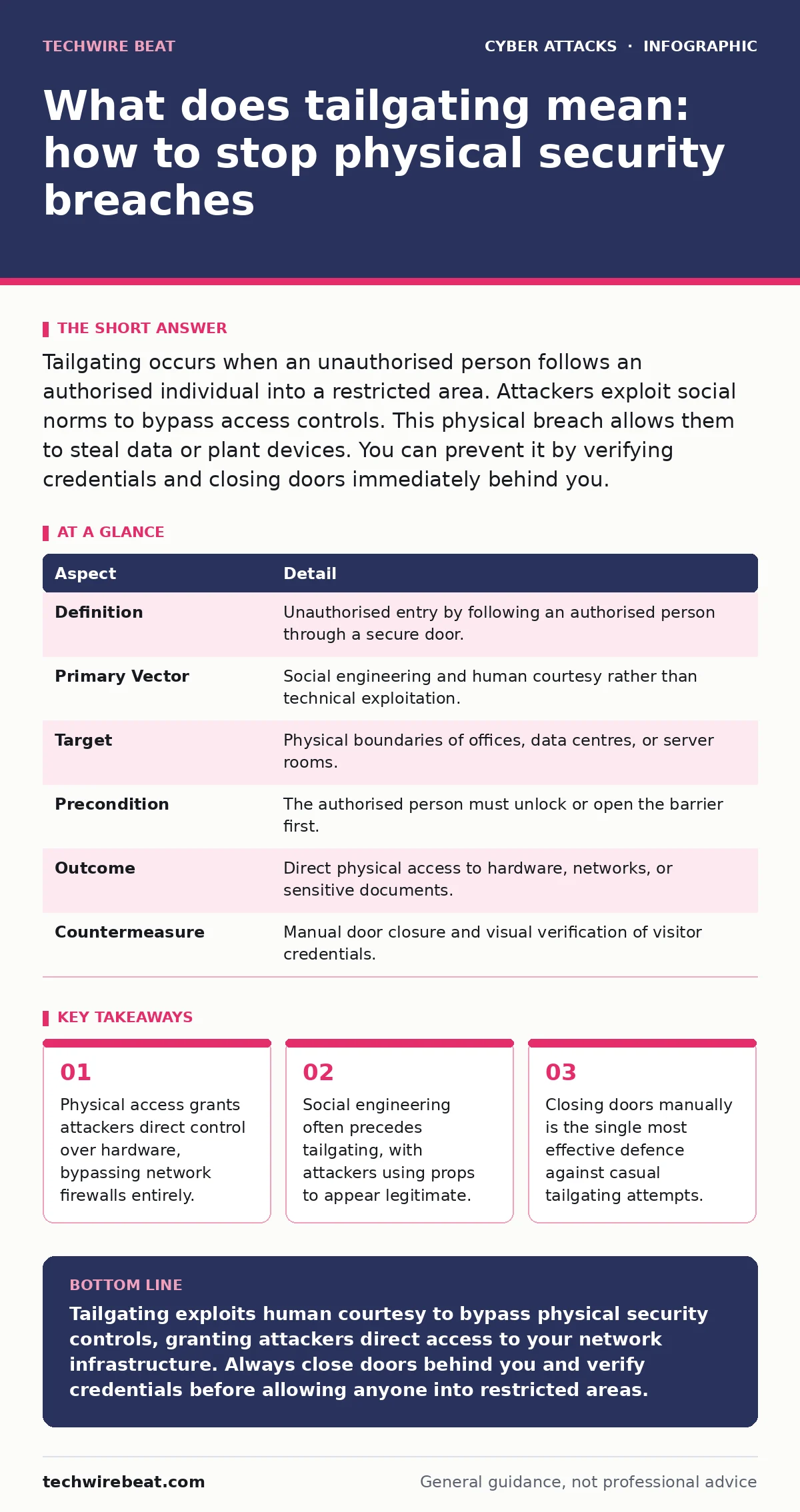
Tailgating occurs when an unauthorised person follows an authorised individual into a restricted area. Attackers exploit social norms to bypass access controls. This physical breach allows them to steal data or plant devices. You can prevent it by verifying credentials and closing doors immediately behind you.
An everyday analogy for physical access
Imagine standing in line at a cinema. The ticket taker scans your wristband and steps through the turnstile. You follow closely behind, not out of malice, but because the door is heavy and you want to hold it open for the person behind you. In this scenario, the person behind you has entered without a ticket. They relied on your action to bypass the check. Tailgating operates on this exact social dynamic. It replaces the ticket scanner with a security door and the cinema with a corporate office. The attacker relies on your politeness or distraction to gain entry.
What does tailgating mean in cybersecurity
Tailgating is a physical security breach where an unauthorised individual gains access to a restricted area by following an authorised person. It is distinct from piggybacking, which implies a consensual act where the authorised person intentionally allows entry. Tailgating exploits the authorised person’s lack of awareness or their desire to be helpful. The attacker does not need technical skills to pick locks or hack card readers. They need only social confidence and a plausible excuse. This method remains effective because physical access controls are often designed for convenience rather than strict verification.
| Aspect | Detail |
|---|---|
| Definition | Unauthorised entry by following an authorised person through a secure door. |
| Primary Vector | Social engineering and human courtesy rather than technical exploitation. |
| Target | Physical boundaries of offices, data centres, or server rooms. |
| Precondition | The authorised person must unlock or open the barrier first. |
| Outcome | Direct physical access to hardware, networks, or sensitive documents. |
| Countermeasure | Manual door closure and visual verification of visitor credentials. |
How the mechanism bypasses security
Security systems assume that if a valid credential is presented, the person holding it is authorised. Tailgating subverts this assumption by separating the credential from the person. The authorised employee swipes their badge or enters a PIN. The door unlocks. The attacker walks through the now-open door. The system records a valid entry event.
No alarm triggers. No log shows a failure. This creates a blind spot in security monitoring. Attackers often carry props to enhance their cover. A laptop bag, a box of equipment, or a uniform can make an attacker appear to belong. They may claim to be from maintenance or delivery services. The goal is to reduce the time between the door opening and their entry.
Who is affected by physical breaches
Every organisation with physical boundaries is vulnerable. Small startups with open-plan offices face risks from casual visitors. Large enterprises with strict badge policies face risks from determined attackers. The impact extends beyond immediate data theft. An attacker inside the building can plug a device into a network port. This device can bridge the internal network to the outside world.
They can install keyloggers on keyboards or cameras in meeting rooms. Physical presence allows attackers to bypass multi-factor authentication because the second factor is often tied to the device or location. If an attacker sits at your desk, they have your computer and your session. They do not need to guess your password.
What people usually get wrong
Many assume that technical security measures prevent physical entry. Firewalls and encryption do not stop someone from walking into a server room. If an attacker has physical access to a server, they can remove the hard drive and read the data offline. They can reset passwords by accessing the BIOS or firmware settings. This is why physical security is the foundation of all other security layers.
Another common mistake is assuming that tailgating is always malicious. Sometimes it is accidental. Employees hold doors for colleagues who forgot their badges. This normalises the behaviour. It creates a culture where checking credentials feels rude or unnecessary. Over time, vigilance erodes. The door becomes a social convenience rather than a security barrier.
See also: Spoofing vs Phishing: The Critical Difference You Must Know
The hidden cost of convenience
Organisations often prioritise ease of movement over strict access control. Turnstiles and mantraps are effective but slow. They create bottlenecks during rush hours. Employees become frustrated. They begin to prop doors open or find ways to bypass the mechanisms. This friction leads to workarounds. Attackers watch for these patterns. They identify which doors are often held open.
They target times when foot traffic is high. The trade-off between security and convenience is real. Choosing convenience increases the risk of tailgating. Choosing strict security reduces usability. The best approach balances both. Use automatic doors that close quickly. Install sensors that alert if a door remains open too long. Train staff to view every entry as a verification point.
Practical steps to prevent entry
You can reduce the risk of tailgating with simple behavioural changes. Always close the door behind you. Do not hold it for strangers. If someone is following you, wait for them to present their credentials. If they do not have a badge, direct them to the reception or security desk. This creates a clear boundary. It signals that access is controlled.
Look at the person behind you. Make eye contact. This simple act often stops casual tailgaters. They rely on anonymity and distraction. Direct attention breaks their cover. Report suspicious behaviour to security teams. Consistency is key. If some employees enforce rules and others do not, the system fails. Everyone must participate in the defence.
Integrating physical and digital defence
Physical security cannot exist in isolation. It must connect with digital monitoring. Access logs should correlate with badge swipes. If a door opens but no badge is recorded, an alert should trigger. Video surveillance can verify that only authorised persons enter. Some organisations use hardware security keys that require physical possession for certain actions.
This adds a layer of verification. Even if an attacker tails an employee into the office, they cannot access critical systems without the key. Combining physical barriers with digital verification creates a deeper defence. It forces attackers to overcome multiple hurdles. This increases the effort and risk for them.
When usual advice fails
Standard advice often suggests "be vigilant". This is vague and ineffective under pressure. In a busy lobby, vigilance is hard to maintain. Specific instructions work better. "Close the door immediately" is actionable. "Check for badges" is measurable. Another failure point is the assumption that tailgating only happens at main entrances.
Side doors, loading bays, and parking garage exits are often less monitored. Attackers target these weak points. They know security focuses on the front. Diversify your physical security checks. Ensure all entry points have the same level of control. Do not leave secondary doors unlocked for "emergency access" without proper logging.
The role of culture in security
Security is a cultural issue as much as a technical one. Leaders must model the correct behaviour. If executives hold doors for unbadged guests, staff will follow suit. Training should focus on the "why" behind the rules. Explain how physical access leads to data breaches. Connect the physical act to the digital consequence. This helps employees understand the stakes. Encourage a culture where questioning access is normal. It should not feel confrontational. Frame it as a routine check. "Do you have a visitor badge?" is a neutral question. It avoids accusation. It simply states the requirement. Over time, this becomes habit. The door becomes a checkpoint, not a barrier.
Key takeaways
- Physical access grants attackers direct control over hardware, bypassing network firewalls entirely.
- Social engineering often precedes tailgating, with attackers using props to appear legitimate.
- Closing doors manually is the single most effective defence against casual tailgating attempts.
Tailgating exploits human courtesy to bypass physical security controls, granting attackers direct access to your network infrastructure. Always close doors behind you and verify credentials before allowing anyone into restricted areas.
Frequently asked questions
Is tailgating illegal?
Yes, unauthorised entry into private property is illegal. It can lead to trespassing charges and civil liability for the organisation if data is stolen.
How is tailgating different from piggybacking?
Piggybacking is consensual, where an authorised person intentionally lets someone in. Tailgating is unconsensual, relying on the target’s lack of awareness or distraction.
Can technology prevent tailgating?
Technology like mantraps and sensors helps, but human behaviour is the primary factor. Technology alerts you to breaches, but people must enforce the rules.
What should I do if I see someone tailgating?
Politely ask them to wait while you close the door. Then ask them to present their credentials or direct them to the reception area for verification.
How this guide was produced: written by the TechWire Beat editorial team with AI assistance, checked against the public references listed below, and reviewed when the facts change. See our editorial policy or report an error.