OAuth vs SAML: Which Authentication Protocol Fits Your Architecture?
OAuth delegates access rights without sharing credentials, whereas SAML exchanges identity assertions to prove who you are across separate systems.

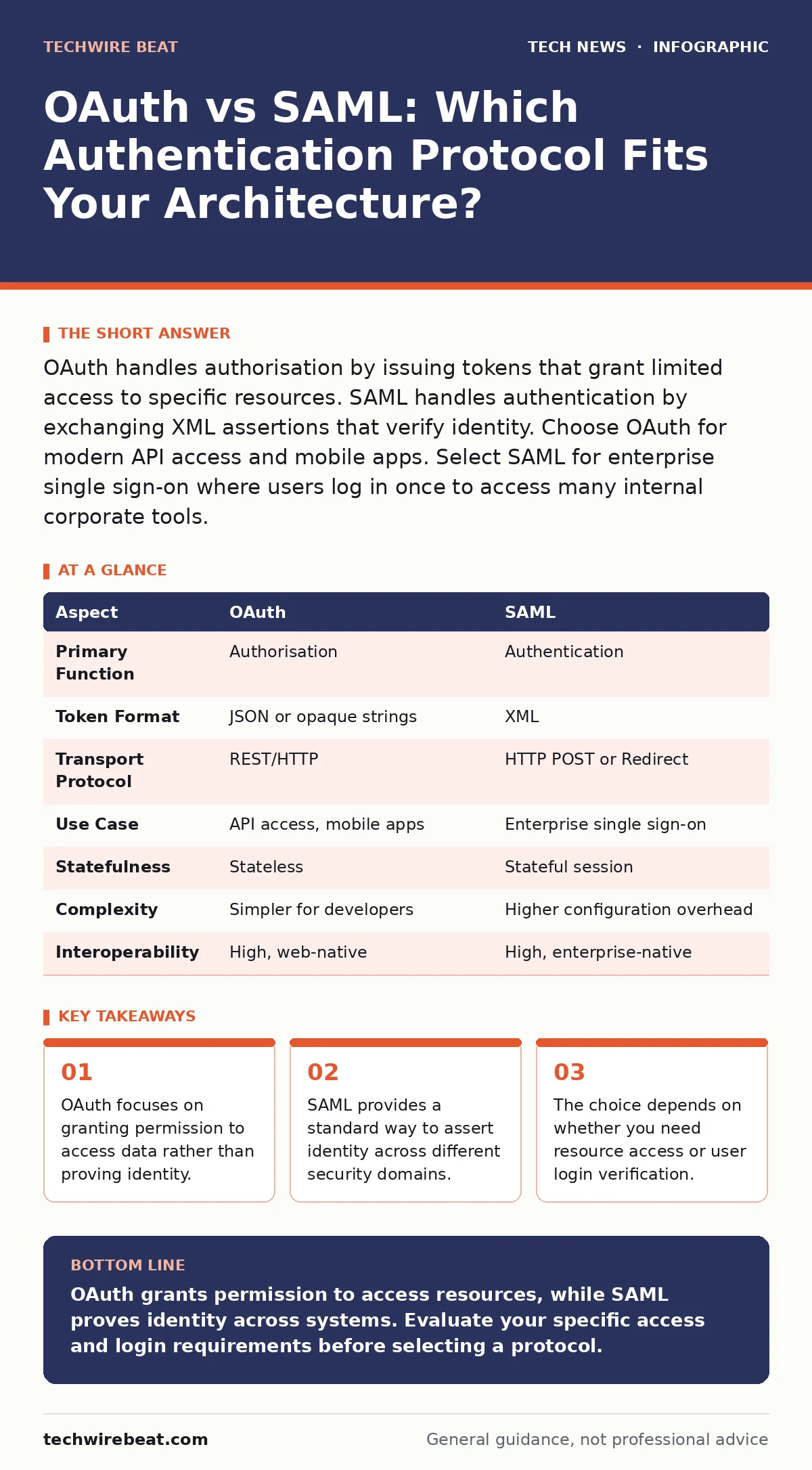
OAuth handles authorisation by issuing tokens that grant limited access to specific resources. SAML handles authentication by exchanging XML assertions that verify identity. Choose OAuth for modern API access and mobile apps. Select SAML for enterprise single sign-on where users log in once to access many internal corporate tools.
The Core Difference Between OAuth and SAML
OAuth and SAML solve different problems in digital security. OAuth is an authorisation framework that allows applications to obtain limited access to user accounts on an HTTP service. It does not tell the application who the user is, only that the user has granted permission. SAML, or Security Assertion Markup Language, is an authentication standard. It allows a user to authenticate with one identity provider and use those credentials with multiple service providers. Understanding OAuth vs SAML requires distinguishing between proving who you are and proving what you are allowed to do.
What OAuth Actually Does
OAuth operates on the principle of delegation. When you connect a third-party application to your social media account, you use OAuth. The application receives an access token, not your password. This token grants specific permissions, such as reading your profile picture or posting on your behalf. The scope of the token is limited and time-bound. If the token is compromised, the attacker can only access the resources defined in that scope. This mechanism prevents credential stuffing attacks because the application never sees the actual login details.
What SAML Actually Does
SAML enables single sign-on by exchanging security tokens between an identity provider and a service provider. When you log into your corporate network, SAML allows you to access email, HR systems, and project management tools without logging in again. The identity provider sends an XML-based assertion to the service provider. This assertion contains claims about the user, such as their role or group membership. The service provider trusts the identity provider and accepts the assertion as proof of identity. This reduces password fatigue and centralises identity management.
OAuth vs SAML: Point-by-Point Comparison
| Aspect | OAuth | SAML |
|---|---|---|
| Primary Function | Authorisation | Authentication |
| Token Format | JSON or opaque strings | XML |
| Transport Protocol | REST/HTTP | HTTP POST or Redirect |
| Use Case | API access, mobile apps | Enterprise single sign-on |
| Statefulness | Stateless | Stateful session |
| Complexity | Simpler for developers | Higher configuration overhead |
| Interoperability | High, web-native | High, enterprise-native |
When to Choose OAuth
Choose OAuth when your primary goal is to allow applications to access user data securely. Modern web and mobile applications rely heavily on APIs. OAuth provides a standardised way for these applications to request and receive access tokens. It is ideal for scenarios where users expect to connect multiple services, such as linking a fitness tracker to a health app. The stateless nature of OAuth tokens makes them suitable for distributed systems and microservices architectures. They scale well because each request is independent.
- Your application needs to access user data from other services.
- You are building a mobile or single-page web application.
- You want to avoid handling user passwords directly.
See also: One-time password meaning: how the code works and why it fails
When to Choose SAML
Choose SAML when you need to manage user access across multiple enterprise applications. Large organisations often have dozens of internal tools. SAML allows employees to log in once and access all authorised resources. It is the standard for corporate single sign-on because it supports complex identity attributes. These attributes can include department, security clearance, or employee status. SAML integrates well with existing directory services like LDAP or Active Directory. It provides a consistent login experience for employees.
- You are implementing enterprise single sign-on.
- You need to pass complex user attributes between systems.
- Your organisation uses legacy applications that support SAML.
Where They Overlap and Combine
In practice, OAuth and SAML often work together. Many identity providers support both protocols. A user might authenticate via SAML to log into a corporate portal. Then, they might use OAuth to grant a specific application access to their data within that portal. This hybrid approach leverages the strengths of both standards. SAML handles the initial identity verification, while OAuth manages the fine-grained access control. This separation of concerns enhances security and flexibility. It allows organisations to maintain strict identity policies while enabling modern application development.
Security Considerations for Both Protocols
Both protocols require careful implementation to avoid vulnerabilities. OAuth tokens can be intercepted if not transmitted over secure connections. Always enforce HTTPS for all token exchanges. SAML assertions can be tampered with if signatures are not validated properly. Ensure that service providers verify the digital signature of every SAML assertion. Regularly audit your configurations to ensure they align with current best practices. Misconfigurations are a leading cause of security breaches in identity management. Proper validation of origins and callbacks is necessary for OAuth. Strict certificate management is required for SAML.
Integrating With Broader Security Strategies
Identity protocols do not exist in isolation. They interact with other security mechanisms. For example, proper network ports and protocols management ensures that identity traffic is not exposed to untrusted networks. Certificate management is also relevant. While Certificate Transparency primarily applies to public web certificates, the principle of verifying trust chains applies to SAML signatures. Similarly, DNSSEC helps protect the resolution of identity provider domains, preventing man-in-the-middle attacks. A holistic security strategy considers how identity protocols fit into the wider infrastructure.
Key takeaways
- OAuth focuses on granting permission to access data rather than proving identity.
- SAML provides a standard way to assert identity across different security domains.
- The choice depends on whether you need resource access or user login verification.
OAuth grants permission to access resources, while SAML proves identity across systems. Evaluate your specific access and login requirements before selecting a protocol.
Frequently asked questions
Can OAuth be used for single sign-on?
OAuth 2.0 combined with OpenID Connect can handle single sign-on by adding identity layers, but pure OAuth only handles authorisation.
Is SAML more secure than OAuth?
Neither is inherently more secure. Security depends on correct implementation, token handling, and signature validation for each protocol.
Which protocol is better for mobile apps?
OAuth is generally preferred for mobile apps due to its lightweight JSON tokens and ease of integration with modern APIs.
Do I need both protocols in my organisation?
Many organisations use SAML for internal employee login and OAuth for external application access, combining both for comprehensive coverage.
How this guide was produced: written by the TechWire Beat editorial team with AI assistance, checked against the public references listed below, and reviewed when the facts change. See our editorial policy or report an error.