Anonymization vs Pseudonymization: The Difference That Protects Data
Pseudonymization keeps data usable for analysis while reducing risk, whereas true anonymization severs the link to identity permanently.

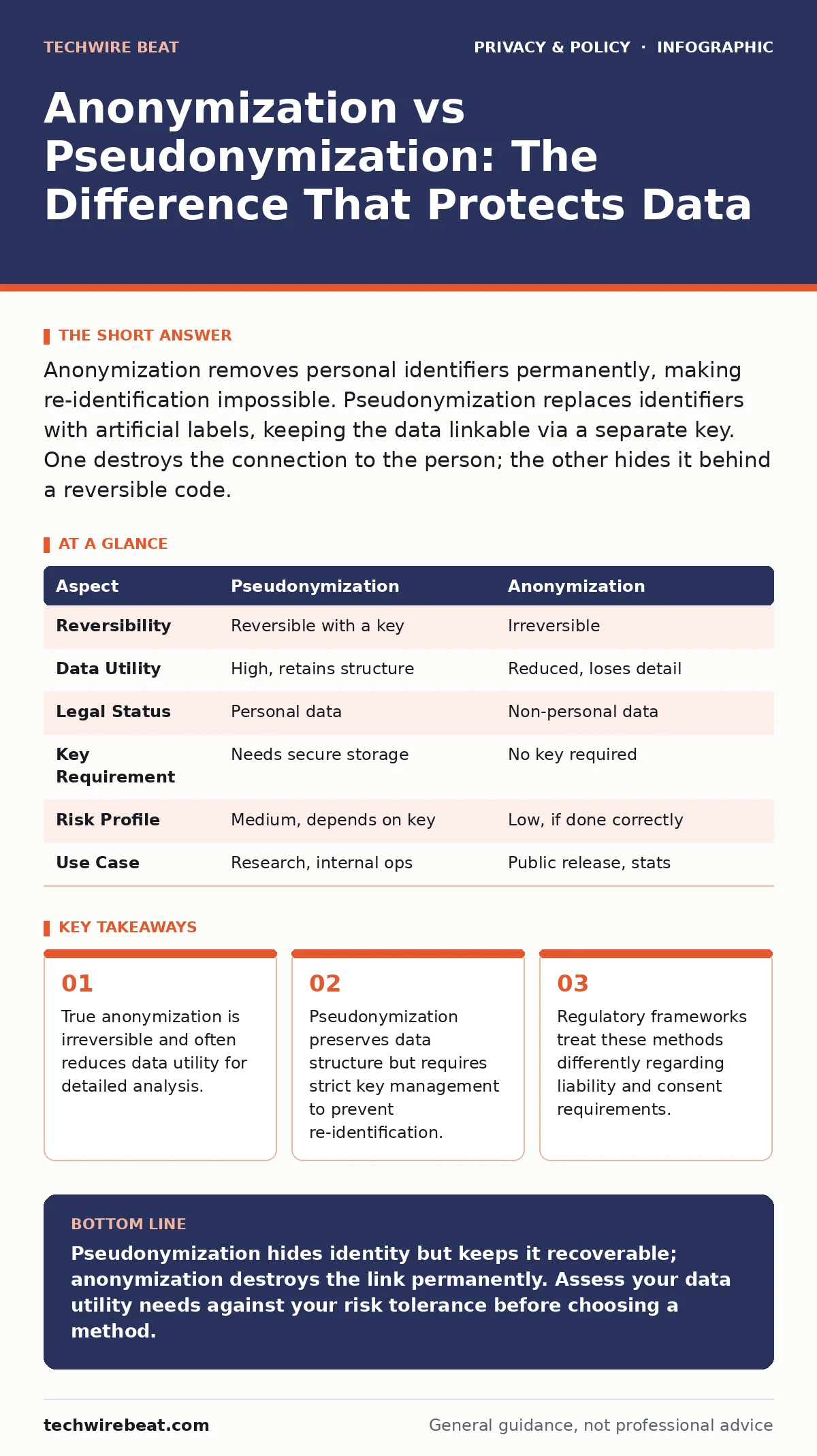
Anonymization removes personal identifiers permanently, making re-identification impossible. Pseudonymization replaces identifiers with artificial labels, keeping the data linkable via a separate key. One destroys the connection to the person; the other hides it behind a reversible code.
The Fundamental Distinction in Identity Management
The core difference lies in reversibility. Anonymization strips data of all identifiers so thoroughly that the original individual cannot be distinguished from the group. Once processed, there is no technical path back to the source. Pseudonymization substitutes direct identifiers with artificial identifiers, such as random codes. The original data remains recoverable if you possess the additional information, known as the key, required to reverse the process.
This distinction dictates how you handle risk. When data is anonymous, it generally falls outside the scope of strict privacy regulations because it no longer concerns a living individual. Pseudonymized data, however, remains personal data. It offers a layer of security but retains the legal weight of identifiable information. You must understand this boundary before designing any data handling strategy.
How Pseudonymization Works in Practice
Pseudonymization operates by replacing fields like names or email addresses with pseudonyms. Imagine a healthcare database where patient names are replaced with unique alphanumeric strings. The clinical records remain intact, allowing researchers to track outcomes over time. The link between the string and the patient’s name exists in a separate, securely stored file.
This method supports longitudinal studies. You can analyze trends without exposing identities during routine processing. However, the security of the entire system hinges on the protection of the re-identification key. If an attacker gains access to both the pseudonymized dataset and the key, the privacy protection fails completely. This creates a single point of failure that requires rigorous access controls.
The Mechanics of True Anonymization
Anonymization aims to make re-identification statistically impossible. Techniques include generalization, where specific ages are replaced with age ranges, and suppression, where rare data points are removed. The goal is to ensure that any individual in the dataset is indistinguishable from others.
This process is often destructive to data utility. High-quality anonymization may require removing so much detail that the data becomes useless for granular analysis. For instance, if you generalize location data to a national level, you lose the ability to study regional health disparities. The trade-off is clear: maximum privacy comes at the cost of data richness.
| Aspect | Pseudonymization | Anonymization |
|---|---|---|
| Reversibility | Reversible with a key | Irreversible |
| Data Utility | High, retains structure | Reduced, loses detail |
| Legal Status | Personal data | Non-personal data |
| Key Requirement | Needs secure storage | No key required |
| Risk Profile | Medium, depends on key | Low, if done correctly |
| Use Case | Research, internal ops | Public release, stats |
When to Choose Pseudonymization
Choose pseudonymization when you need to maintain the integrity of datasets for ongoing analysis. This approach suits internal business operations where different teams need access to the same data over time. It allows for data enrichment, where new information is added to existing records without exposing identities.
It is also suitable when you need to share data with trusted partners who require detailed insights. The partner can work with the pseudonyms, and you retain control over the key. This method aligns well with strategies for data privacy within large organizations that require continuous data flow. It reduces the immediate risk of exposure while preserving the value of the information.
When to Choose Anonymization
Select anonymization when you intend to publish data publicly or share it with untrusted third parties. If the data leaves your control, you must ensure it cannot be traced back to individuals. This is the only safe option for open data initiatives or academic publications where peer review requires full transparency.
Anonymization is also appropriate for historical archives where the identity of the subject is irrelevant to the purpose. You strip away the personal context to leave only the factual core. This approach eliminates regulatory burden entirely, as the data no longer qualifies as personal. It is the final step in data lifecycle management.
See also: Social Media Privacy Concerns: How Platforms Use Your Data · Data Privacy Principles: How to Protect Your Digital Life
The Overlap and Common Pitfalls
The line between these methods can blur in complex datasets. Pseudonymization often serves as a precursor to anonymization. You might pseudonymize data for internal use and then apply further techniques to achieve anonymity before publication. However, relying on pseudonymization as a form of anonymization is a common error.
Quasi-identifiers, such as zip code, gender, and birth date, can often be combined to re-identify individuals even in "anonymous" datasets. This is known as the re-identification risk. You must assess this risk carefully. Simple masking is not enough. You need to evaluate the uniqueness of records within the dataset. Understanding these nuances is critical for conducting effective privacy audits that verify true compliance.
Strategic Implementation for Modern Systems
Implementing these strategies requires a holistic view of your data ecosystem. You cannot treat data in isolation. Consider how secure DNS and other network-level protections complement your data handling policies. Technical measures must align with legal obligations.
For smaller entities, navigating these requirements can be daunting. Familiarity with privacy laws for small businesses can help tailor these complex methods to your scale. You do not need enterprise-grade infrastructure to apply pseudonymization correctly, but you do need discipline in key management.
Long-Term Data Governance
Your choice between these methods affects long-term data governance. Pseudonymized data requires ongoing maintenance of the key and access controls. Anonymized data requires periodic review to ensure that new data sources do not enable re-identification.
As technology evolves, so does the risk of re-identification. What is anonymous today may not be tomorrow. You must build processes that allow for re-evaluation. This dynamic approach ensures that your privacy posture remains effective against emerging threats. It also supports compliance with evolving regulations like children's privacy laws which often demand higher standards of protection.
Key takeaways
- True anonymization is irreversible and often reduces data utility for detailed analysis.
- Pseudonymization preserves data structure but requires strict key management to prevent re-identification.
- Regulatory frameworks treat these methods differently regarding liability and consent requirements.
Pseudonymization hides identity but keeps it recoverable; anonymization destroys the link permanently. Assess your data utility needs against your risk tolerance before choosing a method.
Frequently asked questions
Is pseudonymization enough to meet GDPR requirements?
Pseudonymization is a security measure that helps comply with data protection principles, but it does not exempt you from other obligations like consent or data subject rights.
Can anonymized data ever be re-identified?
While technically impossible by definition, advances in computing and new data sources can sometimes reveal patterns that allow re-identification, requiring ongoing review.
Does encryption count as pseudonymization?
Encryption is a form of pseudonymization if the key is held separately. However, it is often used for transit security, whereas pseudonymization is for storage and processing.
How do I handle mobile app data?
Be wary of **mobile app permission abuse**. Collect only what is necessary, and pseudonymize user identifiers immediately upon collection to minimize exposure.
How this guide was produced: written by the TechWire Beat editorial team with AI assistance, checked against the public references listed below, and reviewed when the facts change. See our editorial policy or report an error.