Backup Strategies: 8 Questions on Offsite and Immutable Storage
Most organisations fail not because they lack copies of data, but because their backups remain vulnerable to the same ransomware that encrypts production systems.

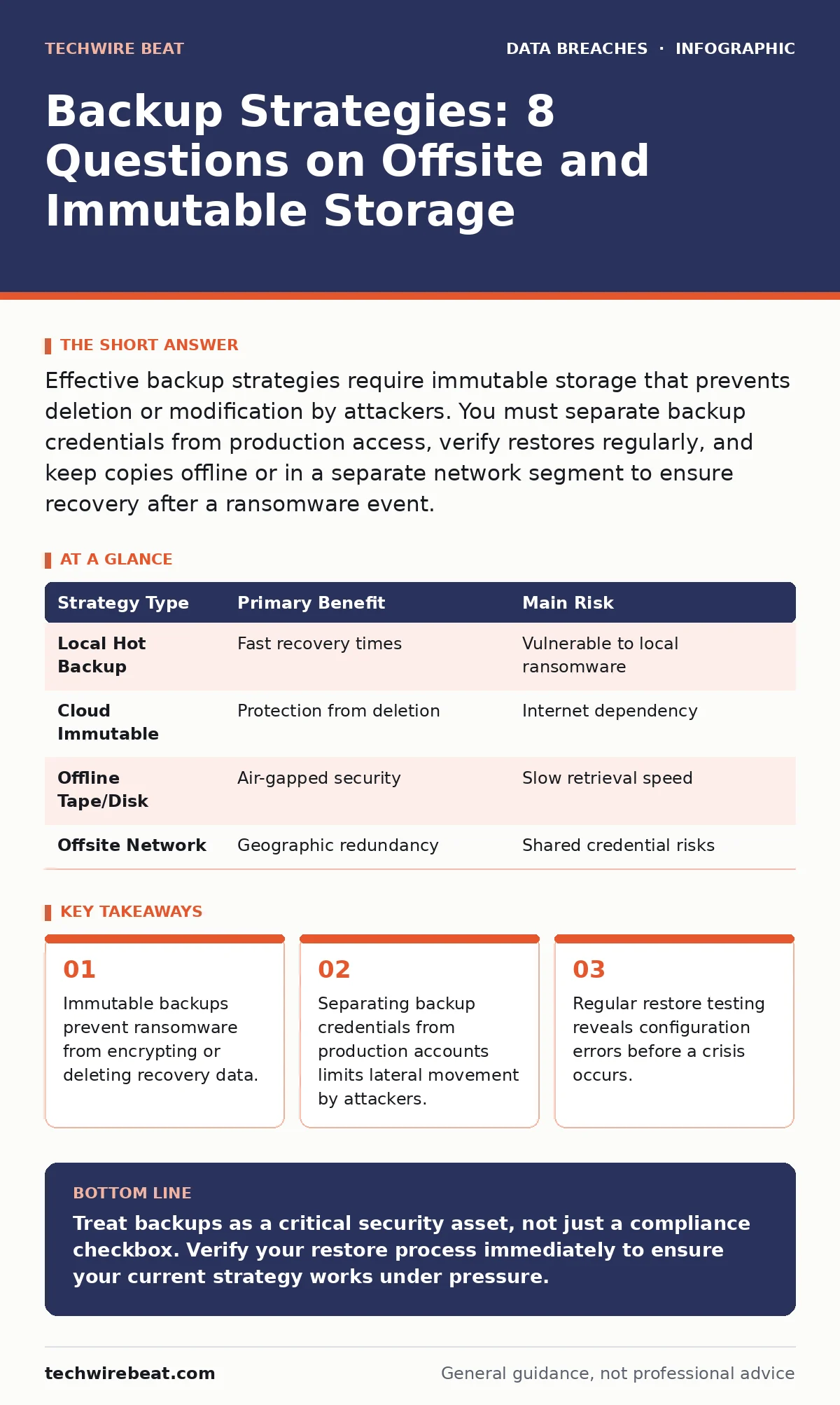
Effective backup strategies require immutable storage that prevents deletion or modification by attackers. You must separate backup credentials from production access, verify restores regularly, and keep copies offline or in a separate network segment to ensure recovery after a ransomware event.
What is the single biggest flaw in most backup plans?
The most common failure is assuming that a backup is safe simply because it exists. Many organisations store backups on the same network as production data, using the same administrative credentials. If an attacker compromises a server, they often inherit the rights to access and delete the backups. This leaves you with encrypted data and no way to recover it.
How does immutability protect against ransomware?
Immutability makes data unchangeable and undeletable for a set period. When you write a backup to an immutable storage system, the system locks the file. Even if an attacker gains root access or administrator privileges, they cannot modify or erase the locked data. This mechanism breaks the ransomware attack chain, forcing criminals to demand payment for data you can simply restore.
Why should backup credentials differ from production accounts?
Using the same credentials for backups and live systems creates a single point of failure. An attacker who steals a production admin password can immediately pivot to the backup infrastructure. By using separate, least-privilege accounts for backup operations, you contain the blast radius. The backup service only needs permission to read production data and write to storage, not to manage the entire network.
Is cloud storage sufficient for disaster recovery?
Cloud storage offers convenience but introduces dependency on internet connectivity and vendor availability. If your primary internet link fails during a disaster, you may not have the bandwidth to restore large datasets in time. Additionally, cloud providers may freeze accounts due to suspicious activity, locking you out of your own data. A hybrid approach that includes local or offline copies mitigates these external risks.
How often should you test restoring data?
You should test restores frequently enough to catch configuration drift and software incompatibilities. A backup that has never been restored is unverified and potentially useless. Schedule monthly restore drills for critical systems and quarterly drills for less critical data. Document the time taken and any errors encountered. This process reveals hidden issues, such as missing dependencies or corrupted media, before a real incident occurs.
| Strategy Type | Primary Benefit | Main Risk |
|---|---|---|
| Local Hot Backup | Fast recovery times | Vulnerable to local ransomware |
| Cloud Immutable | Protection from deletion | Internet dependency |
| Offline Tape/Disk | Air-gapped security | Slow retrieval speed |
| Offsite Network | Geographic redundancy | Shared credential risks |
See also: Password Hygiene Explained: Stop Reusing Keys to Secure Your Digital Life · Credential Dumps Explained: How Stolen Passwords Work
What is the rule of thumb for data retention?
Retain data for as long as legal and operational requirements dictate, but no longer. Keeping old data increases the attack surface and storage costs. Define clear retention policies for different data classes. For instance, financial records may require longer retention than temporary project files. Automated deletion of expired backups prevents clutter and reduces the value of data stolen in a breach.
How do you handle backup encryption keys?
Encryption protects data at rest, but the keys must be stored separately from the encrypted data. If an attacker steals both the backup and the keys, encryption offers no protection. Use a dedicated key management service or hardware security module that is isolated from the backup infrastructure. Ensure that key rotation policies do not inadvertently lock out legitimate restore processes.
Why is monitoring backup jobs critical?
Backup failures are common and often go unnoticed until a restore is needed. Silent failures occur when jobs complete without error but fail to capture recent changes. Monitor job logs for warnings, incomplete transfers, or storage capacity issues. Alerting on backup anomalies allows you to fix problems proactively. A broken backup job is invisible until it is too late to recover lost data.
What is the role of air-gapping in modern infrastructure?
Air-gapping physically disconnects storage from the network. This method provides the highest level of security because it eliminates remote attack vectors. While traditional air-gapping uses removable media, modern implementations use software-defined isolation that mimics physical separation. This approach balances security with operational efficiency, allowing automated backups without exposing the storage to network threats.
How does vendor risk affect backup security?
Third-party vendors often have access to your backup infrastructure for management or support. Weak security practices by a vendor can compromise your entire backup strategy. Evaluate vendors based on their security certifications and incident response capabilities. Require contractual obligations for data protection and breach notification. This aligns with broader principles of vendor risk management, ensuring that external partners do not become weak links in your chain of trust.
Key takeaways
- Immutable backups prevent ransomware from encrypting or deleting recovery data.
- Separating backup credentials from production accounts limits lateral movement by attackers.
- Regular restore testing reveals configuration errors before a crisis occurs.
- Offline or air-gapped storage provides the only defence against network-based attacks.
Treat backups as a critical security asset, not just a compliance checkbox. Verify your restore process immediately to ensure your current strategy works under pressure.
Frequently asked questions
Can ransomware encrypt immutable backups?
No, immutable backups cannot be modified or deleted by anyone, including attackers with administrative privileges, for the duration of the lock period.
How long should I keep backup versions?
Keep versions for as long as needed to recover from delayed detections, typically 30 to 90 days, depending on your operational tolerance for data loss.
Is offsite storage enough?
Offsite storage protects against physical disasters but not against logical attacks like ransomware if the storage is network-accessible and mutable.
What is a synthetic full backup?
It is a backup created by combining a previous full backup with incremental changes, saving bandwidth and storage while maintaining full restore capability.
How this guide was produced: written by the TechWire Beat editorial team with AI assistance, checked against the public references listed below, and reviewed when the facts change. See our editorial policy or report an error.