Deepfake Scams Explained: How to Spot Synthetic Media
Synthetic media can replicate your voice and face with such precision that your trust in your own senses becomes the primary security vulnerability.
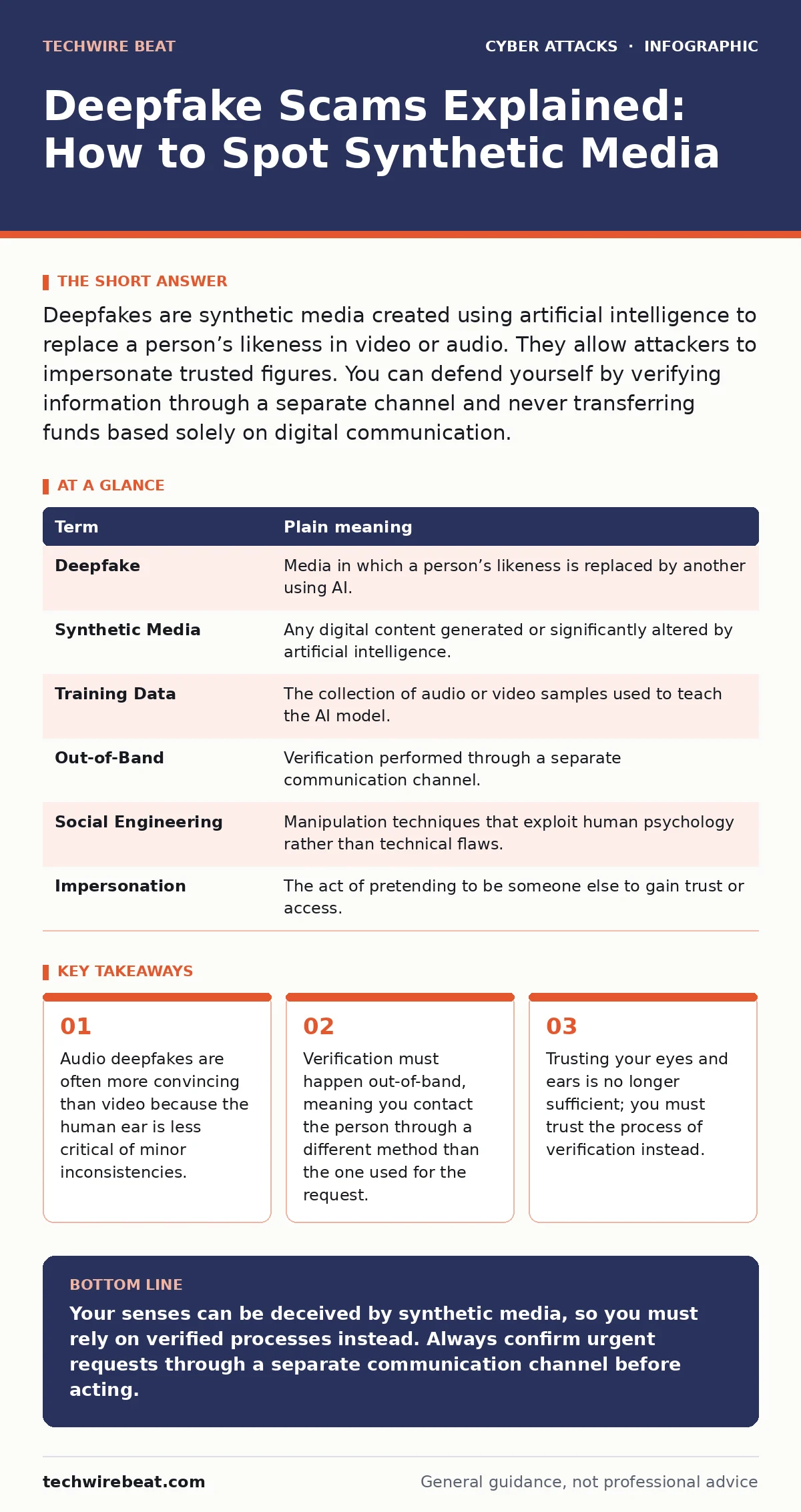
Deepfakes are synthetic media created using artificial intelligence to replace a person’s likeness in video or audio. They allow attackers to impersonate trusted figures. You can defend yourself by verifying information through a separate channel and never transferring funds based solely on digital communication.
The Impersonator at the Door
Imagine you receive a package at your front door. It looks exactly like a delivery from your favourite retailer. The label is correct, the box size matches, and even the tape pattern seems familiar. However, the contents are not what you ordered. This is the core mechanic of a deepfake scam. The attacker does not need to break into your house; they only need to make you open the door willingly.
In the digital world, the package is a message, call, or video. The attacker constructs a convincing exterior that matches your expectations. You see the face of your boss or hear the voice of your bank representative. The presentation is flawless, but the intent is malicious. The goal is to bypass your natural caution by exploiting your trust in familiar signals.
Understanding the Mechanics
Deepfakes rely on machine learning models trained on vast amounts of public data. These models learn the patterns of a person’s speech, facial movements, and mannerisms. The result is a synthetic representation that can generate new content featuring that person. This technology is not magic; it is statistical prediction applied to media files.
The attacker gathers samples of the target’s voice from social media posts or public speeches. They then train a model to mimic those vocal characteristics. Once trained, the model can generate speech that sounds identical to the target. The same process applies to video, where the model maps facial expressions onto a new face. The output is a seamless blend of real and generated data.
| Term | Plain meaning |
|---|---|
| Deepfake | Media in which a person’s likeness is replaced by another using AI. |
| Synthetic Media | Any digital content generated or significantly altered by artificial intelligence. |
| Training Data | The collection of audio or video samples used to teach the AI model. |
| Out-of-Band | Verification performed through a separate communication channel. |
| Social Engineering | Manipulation techniques that exploit human psychology rather than technical flaws. |
| Impersonation | The act of pretending to be someone else to gain trust or access. |
The Audio Threat
Video deepfakes receive most of the attention, but audio is the more immediate threat for ordinary users. High-quality video requires significant computing power and leaves subtle artifacts in the skin texture or lighting. Audio, however, is easier to generate convincingly. The human brain is highly adapted to recognise speech patterns and emotional tones.
An attacker can clone a voice with just a few seconds of clear audio. They can then call you, sounding exactly like a friend or family member in distress. The emotional urgency of the call bypasses your logical assessment. You hear the panic in their voice, which feels real because the AI has replicated the acoustic cues of stress. This is where the analogy of the package fails. You cannot inspect the audio for tampering with the naked eye.
Why Verification Fails
The usual advice is to look for glitches in the video or inconsistencies in the speech. This approach is flawed because the technology improves rapidly. What looks like a glitch today may be indistinguishable from reality tomorrow. Relying on your senses to detect fraud is a losing strategy. The attacker’s goal is to make the synthetic media look and sound perfect.
Instead of inspecting the media, you must inspect the context. Ask yourself why this request is happening now. Is it urgent? Does it involve money or sensitive data? Urgency is a common tactic to prevent you from thinking clearly. The attacker wants you to act before you can verify. By slowing down, you remove the pressure that makes the deepfake effective.
Simple Safety Habits
You can protect yourself by establishing a verification protocol. This does not require expensive software. It requires a change in behaviour. When you receive a request that involves money, passwords, or sensitive information, you must verify it through a different channel. If the request comes via email, call the person on a known phone number. If it comes via a call, send a text message to confirm.
This method is called out-of-band verification. The attacker may control one channel, such as your email or a compromised messaging app. They rarely control all your communication methods simultaneously. By switching channels, you create a path that the attacker has not compromised. This simple step breaks the chain of deception.
- Pause when you receive an urgent request for money or data.
- Contact the person using a method you already know is safe.
- Confirm the request explicitly before taking any action.
See also: Is Passkeys Safe? The Cryptographic Reality Behind Passwordless Login · Difference Between Smishing and Vishing: How Each Attack Works
The Role of Authentication
Technical controls also play a part in defence. While deepfakes target human perception, authentication targets system access. Using multi-factor authentication adds a layer of security that a deepfake cannot bypass. Even if an attacker convinces you to click a link, they cannot log in without your second factor.
However, authentication is not a silver bullet. If the attacker tricks you into handing over your second factor, such as a code sent to your phone, the protection is defeated. This is why security awareness training is valuable. It helps you recognise the social engineering tactics that accompany deepfakes. Understanding the psychology of the attack is as important as the technical defences.
Beyond the Individual
This problem extends beyond personal scams. Businesses face similar risks from business email compromise attacks. An attacker may impersonate a CEO to request a wire transfer. The financial impact can be severe. For organisations, implementing zero trust security principles helps mitigate this risk. This approach assumes that no user or device is trustworthy by default, regardless of their location or identity.
Individuals can adopt a similar mindset. Do not assume that a message from a known contact is safe. Verify the identity of the sender every time the request involves high stakes. This habit creates a culture of scepticism that deepfakes cannot easily penetrate.
Key takeaways
- Audio deepfakes are often more convincing than video because the human ear is less critical of minor inconsistencies.
- Verification must happen out-of-band, meaning you contact the person through a different method than the one used for the request.
- Trusting your eyes and ears is no longer sufficient; you must trust the process of verification instead.
Your senses can be deceived by synthetic media, so you must rely on verified processes instead. Always confirm urgent requests through a separate communication channel before acting.
Frequently asked questions
Can I detect a deepfake by looking at the eyes?
No, modern deepfakes can replicate blinking and eye movement accurately enough to fool human observers.
Do I need special software to protect myself?
No, the most effective protection is behavioural, specifically verifying requests through a different channel.
Are voice calls safer than video calls?
No, voice deepfakes are often more convincing and easier to produce than video deepfakes.
What if I already sent money to a scammer?
Contact your bank immediately to report the fraud and attempt to reverse the transaction.
How this guide was produced: written by the TechWire Beat editorial team with AI assistance, checked against the public references listed below, and reviewed when the facts change. See our editorial policy or report an error.