Exploit Kits: Correcting Common Misconceptions About Automated Attacks
Exploit kits operate as automated marketplaces for vulnerabilities, making the attack surface a dynamic negotiation rather than a static list of known flaws.

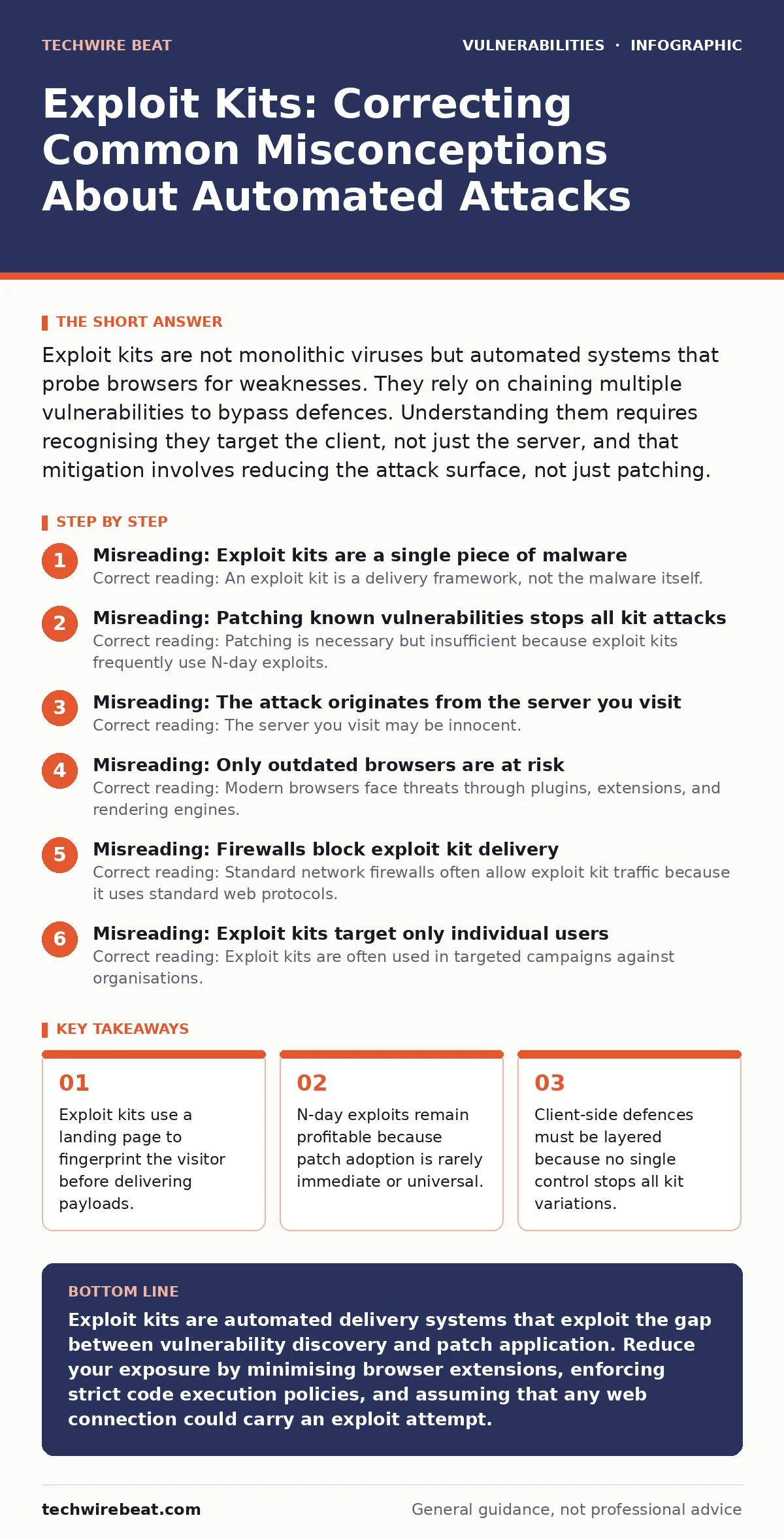
Exploit kits are not monolithic viruses but automated systems that probe browsers for weaknesses. They rely on chaining multiple vulnerabilities to bypass defences. Understanding them requires recognising they target the client, not just the server, and that mitigation involves reducing the attack surface, not just patching.
Misreading: Exploit kits are a single piece of malware
Correct reading: An exploit kit is a delivery framework, not the malware itself. Think of it as a sophisticated vending machine. The kit handles the initial interaction with your browser, checks which security holes exist in your software, and then selects the appropriate exploit to bypass your defences. Only after successfully exploiting a vulnerability does it download the actual malicious payload, such as ransomware or a banking trojan.
This distinction matters because removing the "malware" from your computer does not stop the kit from trying again. The kit lives on a remote server, often hosted on compromised websites. If you focus only on the payload, you ignore the delivery mechanism that allows the attacker to reach you in the first place. You are defending against a process, not a file.
Misreading: Patching known vulnerabilities stops all kit attacks
Correct reading: Patching is necessary but insufficient because exploit kits frequently use N-day exploits. An N-day exploit targets a vulnerability for which a patch already exists but has not yet been applied by your system. Attackers profit from the window between a patch release and widespread adoption.
Imagine you patch a critical flaw in your browser. The kit still works because it chains two other minor flaws that you have not yet addressed. This technique, known as exploit chaining, allows attackers to bypass partial defences. One vulnerability might bypass a specific security control, while another executes the code. Relying solely on patching assumes your environment is perfectly maintained, which is rarely the case in complex IT ecosystems. See our guide on dependency updates for strategies to manage this lag.
Misreading: The attack originates from the server you visit
Correct reading: The server you visit may be innocent. Exploit kits are often hosted on compromised legitimate websites. An attacker hacks a small business website, uploads the kit files, and waits. When you visit that site, your browser requests content from the server. The server serves the kit’s landing page, which then begins scanning your system.
You might trust the domain because it is a well-known brand. The compromise is invisible to you. The server is merely a conduit. This means you cannot rely on reputation alone. The threat is in the code executed by your client, not the identity of the host. This shifts the responsibility from verifying the source to hardening the destination—your device.
Misreading: Only outdated browsers are at risk
Correct reading: Modern browsers face threats through plugins, extensions, and rendering engines. Browsers are complex applications that interpret code from untrusted sources. Even with strict sandboxing, flaws in how the browser renders graphics or handles memory can be exploited.
Exploit kits target these rendering flaws, which are often harder to patch than application logic errors. They also target browser extensions that have access to your browsing data. An extension with excessive permissions can become an entry point. The kit does not need to break the browser core; it can exploit a trusted add-on. This widens the attack surface beyond the browser version number.
Misreading: Firewalls block exploit kit delivery
Correct reading: Standard network firewalls often allow exploit kit traffic because it uses standard web protocols. The kit communicates over HTTP or HTTPS, the same protocols used for legitimate web browsing. Your firewall sees an encrypted connection to a web server and permits it.
The attack happens at the application layer, inside your browser. The firewall cannot inspect the encrypted payload for exploit code without significant performance costs and privacy implications. This is why client-side defences are critical. You need controls that understand the context of the code, not just the destination of the traffic. Virtual patching can help here by blocking exploit attempts at the network or application level before they reach the vulnerable code.
See also: CORS Misconfiguration Recovery: Immediate Response and Remediation Steps
Misreading: Exploit kits target only individual users
Correct reading: Exploit kits are often used in targeted campaigns against organisations. Attackers use the kit to deliver custom payloads designed to move laterally within a corporate network. The kit’s automation allows them to test thousands of potential entry points quickly.
This changes the risk profile. It is not just about a user clicking a bad link. It is about an attacker using the kit to find a foothold in your environment. Once inside, they can access internal systems that are not exposed to the internet. This is why threat modeling is vital. You must consider how a compromised endpoint can reach sensitive data. The kit is the key; your internal network is the door.
Misreading: Antivirus software detects the exploit attempt
Correct reading: Traditional antivirus scans for known file signatures. Exploit kits use obfuscation and packing to hide their code. The exploit code is often generated dynamically or encrypted until the moment of execution. This means the signature does not match any known malware database.
The kit may also use fileless techniques, executing code directly in memory. Your antivirus never sees a malicious file on the disk. It sees a legitimate browser process using high memory. This is where behavioural analysis and memory protection become more effective than signature scanning. You need tools that understand what normal browser behaviour looks like and flag deviations.
Misreading: Disabling JavaScript stops all kit activity
Correct reading: While disabling JavaScript reduces risk, it does not eliminate it. Exploit kits can use other technologies such as Flash (historically), Java, or PDF renderers. Even with JavaScript disabled, a vulnerability in your PDF reader or Java runtime can be exploited.
Furthermore, many modern websites require JavaScript to function. Disabling it entirely breaks usability. The trade-off is between security and functionality. A better approach is to use strict Content Security Policy headers and browser features that restrict script execution to trusted sources. This limits the damage a script can do, even if it is not blocked entirely.
Misreading: Exploit kits are a thing of the past
Correct reading: Exploit kits have evolved. They now use advanced evasion techniques, such as checking for virtual machines and sandbox environments. If the kit detects it is being analysed, it may serve benign content. This makes detection and analysis difficult.
They also integrate with ransomware-as-a-service models. The kit delivers the ransomware, which then encrypts files. The economic incentive remains high. As long as there are unpatched vulnerabilities, exploit kits will exist. They adapt to new defences by finding new flaws. The cycle of discovery, exploitation, and patching continues.
Key takeaways
- Exploit kits use a landing page to fingerprint the visitor before delivering payloads.
- N-day exploits remain profitable because patch adoption is rarely immediate or universal.
- Client-side defences must be layered because no single control stops all kit variations.
Exploit kits are automated delivery systems that exploit the gap between vulnerability discovery and patch application. Reduce your exposure by minimising browser extensions, enforcing strict code execution policies, and assuming that any web connection could carry an exploit attempt.
Frequently asked questions
How do I know if my browser has been exploited by a kit?
You often cannot know immediately. Exploit kits are designed to be stealthy. Look for unusual browser behaviour, unexpected pop-ups, or changes to your homepage. Use a dedicated endpoint detection tool that monitors for suspicious process creation.
Are mobile devices vulnerable to exploit kits?
Yes, mobile browsers and apps can be targeted. Mobile operating systems have different security models, but vulnerabilities in rendering engines or plugins can still be exploited. Keep your operating system and apps updated.
Does using a VPN protect me from exploit kits?
No. A VPN encrypts your traffic but does not inspect the content for exploits. If you visit a compromised site, the kit will still be delivered to your browser. The VPN hides your location, not the malicious code.
What is the difference between an exploit kit and a virus?
A virus is a type of malware that replicates itself. An exploit kit is a tool that delivers malware. The kit is the method of infection; the virus is the result. The kit is transient and server-side, while the virus resides on your device.
How this guide was produced: written by the TechWire Beat editorial team with AI assistance, checked against the public references listed below, and reviewed when the facts change. See our editorial policy or report an error.