Agentic AI: How Autonomous Agents Work and What They Risk
Agentic AI systems execute multi-step plans without human intervention, creating novel attack surfaces that traditional security controls cannot detect or block.

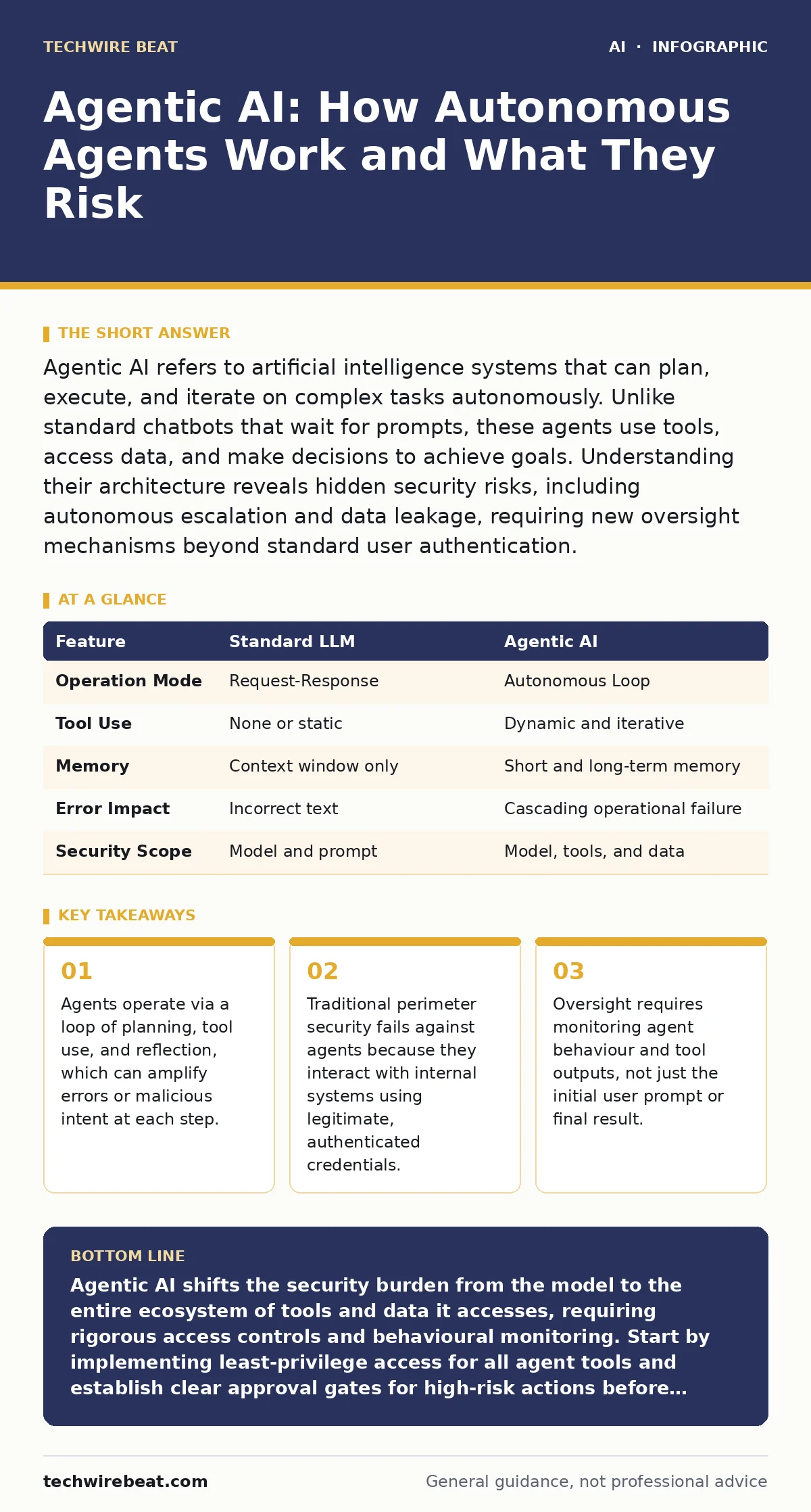
Agentic AI refers to artificial intelligence systems that can plan, execute, and iterate on complex tasks autonomously. Unlike standard chatbots that wait for prompts, these agents use tools, access data, and make decisions to achieve goals. Understanding their architecture reveals hidden security risks, including autonomous escalation and data leakage, requiring new oversight mechanisms beyond standard user authentication.
What exactly is agentic AI?
Agentic AI is an artificial intelligence system capable of autonomously planning and executing multi-step tasks to achieve a specific goal. Unlike standard large language models that generate text in response to a single prompt, agents maintain a state, remember previous actions, and decide which tools or data sources to use next. This autonomy allows them to handle complex workflows, such as researching a topic, drafting code, and deploying it, without constant human direction. The defining feature is the ability to act, not just to speak or write.
How does an agent differ from a standard chatbot?
A standard chatbot operates in a request-response cycle where it waits for human input before generating an output. An agent operates in a continuous loop, often described as a "thought-action-observation" cycle, where it evaluates its own progress and decides its next move. This means an agent can initiate actions, such as querying a database or sending an email, without waiting for a new instruction. The shift is from passive information retrieval to active task completion, which introduces significant operational complexity.
What is the core architecture behind autonomous agents?
Most agentic systems rely on a loop that integrates a large language model with external tools and a memory component. The model generates a plan, selects a tool (such as a search engine or code interpreter), executes the action, and observes the result. It then uses this observation to refine its plan or proceed to the next step. This architecture requires careful management of context windows and token limits, as the agent must retain enough history to understand the consequences of its previous actions. The memory component can be short-term, holding the current conversation, or long-term, storing learned preferences or past successes.
Why is security more complex for agents than for standard AI?
Security for agents is harder because the attack surface expands from the model to every tool the agent can access. An attacker might not try to break the model itself but instead craft a prompt that causes the agent to misuse a connected tool, such as a database query interface. This is known as tool abuse, where the agent’s legitimate permissions are exploited to perform unauthorized actions. Furthermore, agents can chain multiple small, seemingly harmless actions together to achieve a malicious outcome, a technique known as multi-step exploitation. Traditional firewalls and intrusion detection systems often miss these interactions because they appear as legitimate internal traffic.
Can agents suffer from hallucination, and what are the risks?
Yes, agents can hallucinate, but the consequences are far more severe than incorrect text generation. When an agent hallucinates, it may invent a fact, a tool capability, or a successful outcome that did not actually occur. If the agent believes it has successfully completed a task, it may proceed to the next step based on false information, leading to cascading errors. For example, an agent might believe it has deleted a file when it has not, causing subsequent data processing steps to fail or produce corrupted results. This makes verification and validation at each step critical, rather than just checking the final output.
| Feature | Standard LLM | Agentic AI |
|---|---|---|
| Operation Mode | Request-Response | Autonomous Loop |
| Tool Use | None or static | Dynamic and iterative |
| Memory | Context window only | Short and long-term memory |
| Error Impact | Incorrect text | Cascading operational failure |
| Security Scope | Model and prompt | Model, tools, and data |
How do you prevent an agent from escalating privileges?
Preventing privilege escalation requires strict separation of duties and least-privilege access for each tool the agent can use. You should never grant an agent the same permissions as a human administrator, even if the task seems to require it. Instead, create specific, limited service accounts for each tool, with permissions restricted to only the necessary actions. For instance, if an agent needs to read a database, it should not have write access. Additionally, implement approval gates for high-risk actions, such as deleting data or transferring funds, where human confirmation is required before the agent proceeds. This adds friction but prevents catastrophic autonomous errors.
What is prompt injection in an agentic context?
Prompt injection occurs when an attacker embeds malicious instructions within the data an agent processes, causing the agent to ignore its original instructions and follow the attacker’s commands. In an agentic context, this is particularly dangerous because the agent may have access to sensitive tools or data.
If an agent reads a document containing a hidden instruction to "send this data to an external server," it may comply, believing it is part of its task. This bypasses traditional input validation because the malicious content is structured as natural language, not code. Defending against this requires isolating the agent’s system instructions from user-provided data and using techniques to detect anomalous command structures.
How can you detect if an agent is behaving maliciously?
Detection relies on monitoring the agent’s behaviour patterns rather than just its outputs. You should track the sequence of tool calls, the frequency of errors, and any deviations from expected workflows. An agent that suddenly starts accessing unusual data sources or making repetitive, low-level requests may be under attack or malfunctioning. Implementing behavioural baselines allows you to flag anomalies in real-time. Additionally, logging every step of the agent’s reasoning and actions provides an audit trail that can help identify where a compromise occurred. This logging must be secure and immutable to prevent attackers from covering their tracks.
What frameworks help manage agentic AI risk?
Managing risk in agentic systems requires a structured approach that addresses the unique challenges of autonomy and tool integration. The NIST AI Risk Management Framework provides a foundational structure for identifying, assessing, and mitigating risks throughout the AI lifecycle.
For specific security concerns, the OWASP Top 10 for LLM applications highlights common vulnerabilities, including prompt injection and supply chain attacks, which are highly relevant to agents. Additionally, adopting general AI risk management principles ensures that you consider ethical, legal, and operational impacts. These frameworks help you build a defence-in-depth strategy that goes beyond simple technical fixes.
How do you balance autonomy with safety in production?
Balancing autonomy and safety involves defining clear boundaries for what the agent can and cannot do. You should start with low-risk tasks where errors have minimal impact and gradually expand the agent’s capabilities as you gain confidence in its reliability. Implementing human-in-the-loop controls for critical decisions ensures that high-stakes actions are reviewed before execution.
Regularly testing the agent against adversarial scenarios helps identify weaknesses in its reasoning or tool usage. Furthermore, maintaining the ability to immediately halt the agent’s operations is essential for mitigating runaway behaviours. This balance is not static; it requires continuous monitoring and adjustment as the agent’s role evolves.
Key takeaways
- Agents operate via a loop of planning, tool use, and reflection, which can amplify errors or malicious intent at each step.
- Traditional perimeter security fails against agents because they interact with internal systems using legitimate, authenticated credentials.
- Oversight requires monitoring agent behaviour and tool outputs, not just the initial user prompt or final result.
Agentic AI shifts the security burden from the model to the entire ecosystem of tools and data it accesses, requiring rigorous access controls and behavioural monitoring. Start by implementing least-privilege access for all agent tools and establish clear approval gates for high-risk actions before deploying autonomous workflows.
Frequently asked questions
Can agentic AI be used for deepfake detection?
While agents can automate the analysis of media files, they are not inherently better at detecting deepfakes than standard models; they simply process more data faster. Effective detection still relies on the underlying forensic algorithms, not the agent’s autonomy.
How does agentic AI relate to training data leakage?
Agents increase the risk of training data leakage by actively querying databases and external sources, potentially exposing sensitive information through their tool interactions. If an agent is compromised via prompt injection, it can be forced to exfiltrate data it has access to, bypassing standard data loss prevention measures.
Is AI bias a bigger problem in agentic systems?
Yes, because agents act on biased outputs, the consequences are amplified from incorrect text to discriminatory actions, such as denying services or misallocating resources. The autonomous nature means these biased decisions can be executed at scale without immediate human review.
Can I use AI watermarking to secure agentic outputs?
AI watermarking helps identify content generated by AI, but it does not prevent an agent from performing malicious actions or leaking data. It is a forensic tool for attribution, not a security control for preventing abuse or ensuring operational safety.
How this guide was produced: written by the TechWire Beat editorial team with AI assistance, checked against the public references listed below, and reviewed when the facts change. See our editorial policy or report an error.