Meta’s open AI model brings agentic tools to dual Mac Studio setups
Meta releases Muse Spark Open, an 816B-parameter model with a million-token context that runs on Apple Silicon for desktop use.
Key points
- The open-weight model activates 42 billion parameters per token while holding 816 billion total.
- It achieves top scores in tool-use benchmarks but trails rivals in coding tasks.
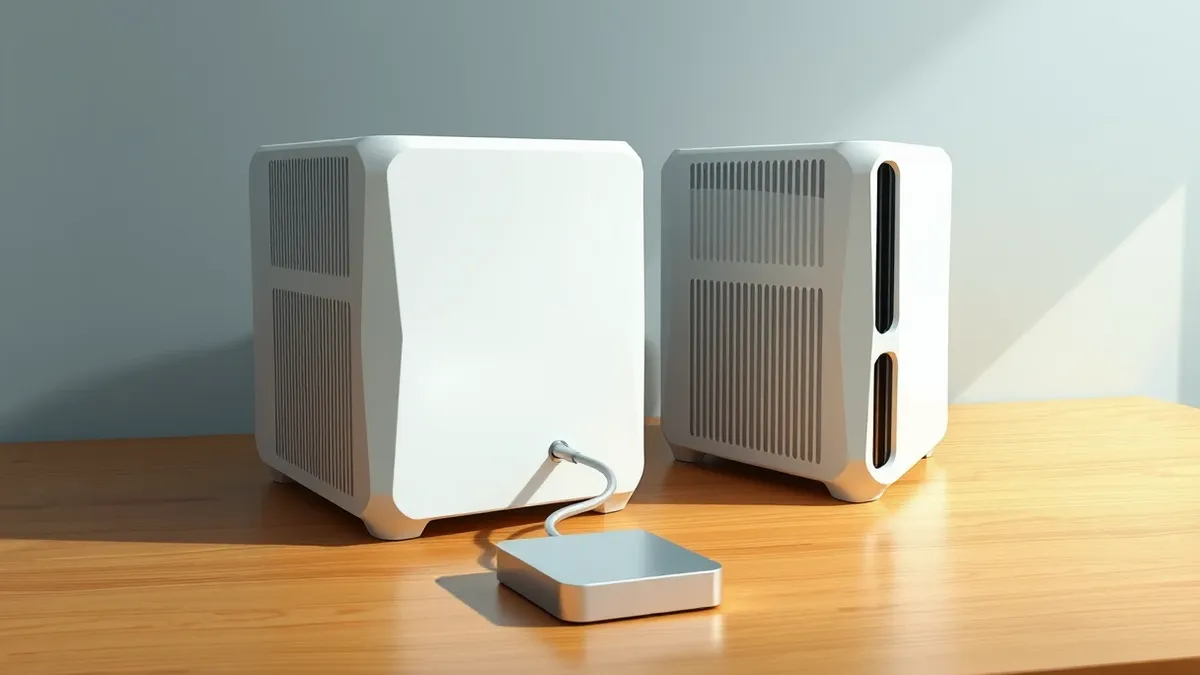
- Deployment requires two Apple M5 Ultra Mac Studios or equivalent high-end GPU clusters.
Meta has released Muse Spark Open, an artificial intelligence model designed to run on desktop computers rather than large cloud servers. According to MarkTechPost, this release allows organisations to process complex tasks locally using Apple Silicon hardware. The model is described by Meta AI Research as the most capable open-weight system from the United States, offering a one-million-token context window for extended reasoning and document analysis.
The system uses a mixture-of-experts architecture, meaning it contains 816 billion total parameters but only activates 42 billion for each token processed. This design enables efficient operation on two Apple M5 Ultra Mac Studios, each equipped with 512 gigabytes of memory. Developers can also deploy the model on clusters of Blackwell Ultra GPUs or H200 accelerators using compressed formats, according to the technical specifications shared by Meta.
What we know
Meta Superintelligence Labs published the weights for Muse Spark Open on Hugging Face in both BF16 and NVFP4 formats. The model accepts text, image, video and audio inputs, returning text outputs. It features a separate 1.8 billion-parameter perception encoder for visual data and supports reasoning effort levels from low to extra high. The training data covers more than 100 languages, and the model underwent additional safety post-training to improve robustness without relying on system-level guardrails.
Performance testing shows strong results in agentic tool use. On the MCP-Atlas benchmark, Muse Spark Open scored 89.2, surpassing Qwen3.8 and GLM 5.3. It also led on JobBench and AA Omniscience metrics. However, coding performance remains a relative weakness. On Terminal-Bench 2.1, it scored 76.4, falling behind Kimi K3, GLM 5.3 and Qwen3.8, which achieved higher marks in that specific category.
Defender's checklist
- Verify the integrity of downloaded model weights from official Hugging Face repositories before deployment.
- Ensure local hardware meets the minimum memory requirements, such as dual Mac Studios with 512 GB each.
- Configure reasoning effort settings appropriately to balance processing speed and computational resource usage.
- Monitor system logs for unusual behaviour when running untrusted prompts through the local model instance.
The background in plain language
Organisations adopting local AI models must understand that open-weight systems allow full inspection of the underlying code. This transparency helps teams verify safety measures and data handling practices before deployment. Local processing keeps sensitive information within the corporate network, reducing exposure to external data leaks. Teams usually evaluate these models against specific task benchmarks to ensure they meet operational standards. Checking whether the hardware can sustain the required memory load is essential for stable performance.
What to do and how to stay safe: Meta
- Assess whether your organisation’s data privacy requirements necessitate local model deployment over cloud-based alternatives.
- Review the hardware specifications required to run the model efficiently, ensuring sufficient memory and processing power are available.
- Test the model with internal datasets to verify its performance in coding and tool-use scenarios matches your operational needs.
- Implement monitoring protocols to track resource consumption and output quality once the model is integrated into your workflow.
Step-by-step guide: AI Governance for Small Teams: Practical Controls and Cost
General security guidance from the TechWire Beat newsroom. It is not confirmed advice from the organisations named in this story.
Frequently asked questions
What hardware is required to run Muse Spark Open?
The model runs on two Apple M5 Ultra Mac Studios with 512 GB of memory each, or on clusters of Blackwell Ultra GPUs or H200s.
How does Muse Spark Open perform in coding tasks?
It scores 76.4 on Terminal-Bench 2.1, which is lower than competitors like Kimi K3, GLM 5.3 and Qwen3.8.
Is Muse Spark Open available for immediate use?
Yes, Meta AI Research states the model is available today with weights released on Hugging Face.