AI Bias Explained: Why Algorithms Make Unfair Choices
See how training data shapes automated decisions and learn why removing human input does not remove human prejudice from the output.

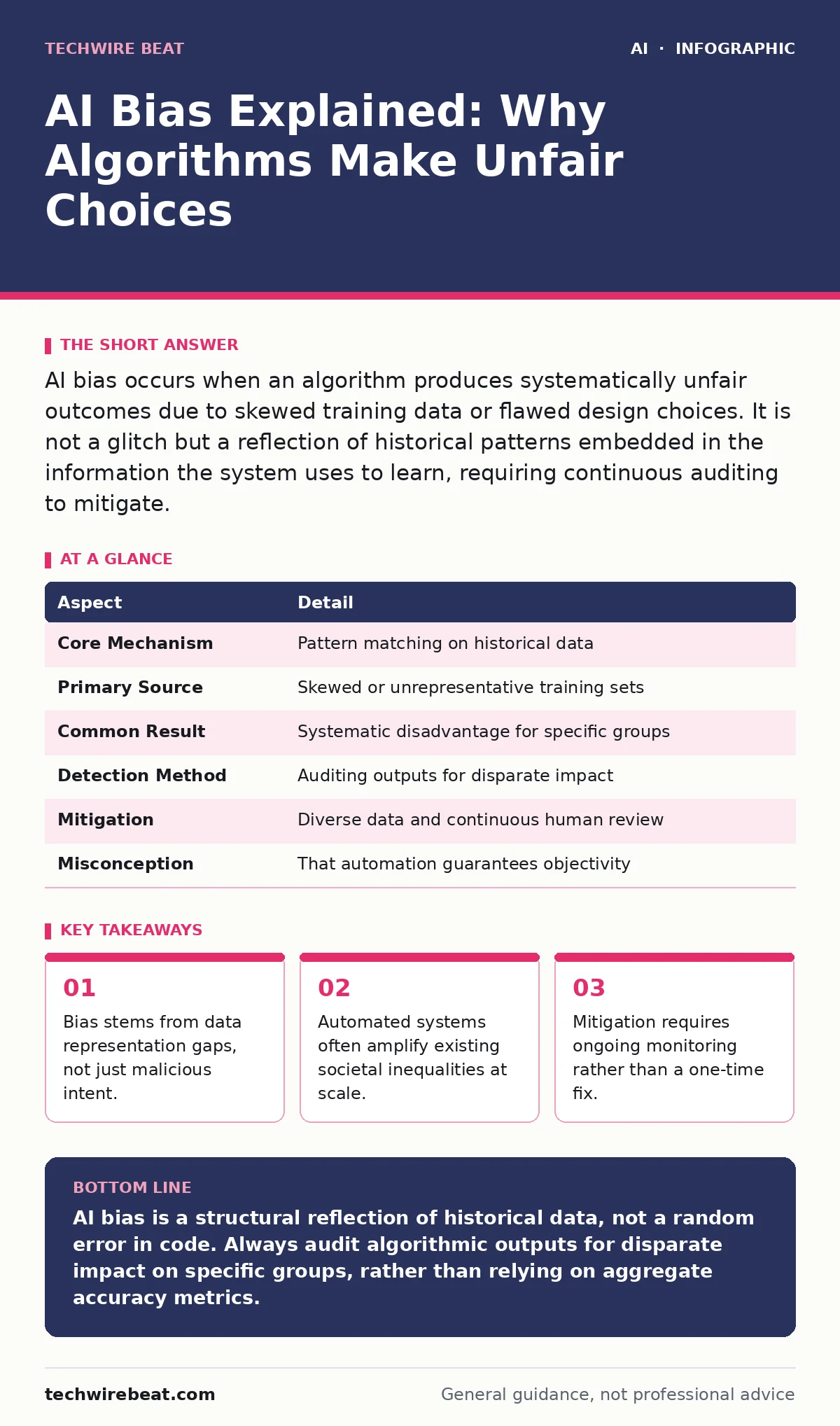
AI bias occurs when an algorithm produces systematically unfair outcomes due to skewed training data or flawed design choices. It is not a glitch but a reflection of historical patterns embedded in the information the system uses to learn, requiring continuous auditing to mitigate.
The Mirror and the Distortion
Imagine a photographer who only ever takes pictures of people standing in bright sunlight. If you ask that photographer to describe what humans look like in the evening, they will struggle. Their camera has captured a reality, but it is a narrow slice of the truth. This is the fundamental mechanism behind artificial intelligence bias. The system is not lying; it is simply reflecting the limited world it has been shown.
Most people assume that algorithms are neutral mathematical engines. They believe that if you remove human emotion from the decision-making process, you remove prejudice. This assumption is incorrect. An algorithm is a pattern-matching tool. It learns by finding correlations in large sets of data. If the data contains historical inequalities, the algorithm will learn those inequalities as facts. It does not know what fairness is. It only knows what frequency is.
Where the Term Comes From
In everyday practice, however, the term describes the tangible harm caused when these statistical deviations affect real people. It is not an abstract error in a spreadsheet. It is a loan application denied because the model learned that certain postcodes correlate with lower repayment rates, ignoring the specific financial health of the applicant.
The term gained prominence as automated systems moved from calculating stock prices to screening job candidates and assessing criminal risk. As these systems touched more aspects of daily life, the cost of error increased. A biased recommendation engine might show you irrelevant ads. A biased hiring tool might exclude qualified candidates from entire demographic groups. The distinction is between inconvenience and exclusion.
| Aspect | Detail |
|---|---|
| Core Mechanism | Pattern matching on historical data |
| Primary Source | Skewed or unrepresentative training sets |
| Common Result | Systematic disadvantage for specific groups |
| Detection Method | Auditing outputs for disparate impact |
| Mitigation | Diverse data and continuous human review |
| Misconception | That automation guarantees objectivity |
How It Manifests in Daily Life
You encounter AI bias every time you interact with a search engine, a social media feed, or a banking app. These systems use machine learning, a subset of AI where computers improve their performance through experience, to predict what you want or need. If the historical data shows that men are more likely to click on certain job ads, the system will show those ads to men more often. This creates a feedback loop. The bias reinforces itself because the system sees fewer clicks from women and assumes the content is irrelevant to them.
Consider facial recognition software used for security. These systems often struggle to identify people with darker skin tones. This is not because the technology is inherently incapable. It is because the images used to train the system were predominantly of lighter-skinned individuals. The model learned the features of that group better than others. When it encounters a face it has not seen enough of, it makes errors. These errors are not random. They are concentrated in groups that were underrepresented in the training phase.
What People Usually Get Wrong
There is a persistent belief that bias is a result of the programmer’s personal prejudice. While a developer can certainly introduce bias through poor design choices, most bias is structural. It exists in the data itself. Even if a team is diverse and well-intentioned, they cannot fix a dataset that does not represent the population they serve. The problem is not the coder’s heart; it is the mirror’s angle.
Another common error is assuming that adding more data will always solve the problem. Quantity does not fix quality. If you add more data that is still skewed, you simply make the bias more statistically significant. The system becomes more confident in its wrong assumptions. You need not just more data, but more representative data. You must also define what fairness means for your specific use case. Is it equal outcomes? Equal opportunity? The definition changes the technical approach.
The Hidden Cost of 'Neutral' Models
When organisations try to remove bias, they often focus on removing protected attributes like race or gender from the data. This is called blind auditing. It seems like a safe approach. However, it fails because other variables often act as proxies for these attributes. Zip code, for example, can strongly correlate with race in many countries. Education level can correlate with socioeconomic status. If the algorithm uses zip code to predict risk, it effectively discriminates by race, even if the word "race" never appears in its code.
This proxy effect makes bias difficult to detect. The model looks clean on the surface. It does not use forbidden variables. But the output still shows disparate impact. To catch this, you must look at the results, not just the inputs. You must ask whether the model’s decisions hurt one group more than another, regardless of which variables it used to make those decisions. This requires a shift from checking the ingredients to tasting the final dish.
Why 'Fixing' It Is an Ongoing Process
AI bias is not a bug you patch once. It is a condition you manage. The world changes, and so does the data. A model trained on data from five years ago may be accurate for the past but biased against the present. Social norms shift, economic conditions change, and new groups emerge. A static model becomes stale and increasingly unfair over time. This is known as model drift.
Continuous monitoring is the only way to stay ahead of this. You need systems that flag when performance drops for specific subgroups. You need processes to retrain models with fresh, representative data. This is expensive and resource-intensive. Many organisations choose to deploy models and forget them because it is cheaper. This short-term savings leads to long-term reputational and legal risk. The cost of inaction is often higher than the cost of maintenance.
Practical Steps for Awareness
You do not need to be a data scientist to understand bias. You can start by asking simple questions about the systems you use or build. Who created this model? What data was used to train it? Who is excluded from that data? These questions reveal the blind spots.
For organisations, the first step is documentation. Record why you made certain design choices. Record what data you excluded and why. This creates an audit trail. If a decision goes wrong, you can trace it back to the source. For individuals, the step is scepticism. Treat automated recommendations as suggestions, not truths. Understand that the system is optimising for a metric, not for your well-being.
Key takeaways
- Bias stems from data representation gaps, not just malicious intent.
- Automated systems often amplify existing societal inequalities at scale.
- Mitigation requires ongoing monitoring rather than a one-time fix.
AI bias is a structural reflection of historical data, not a random error in code. Always audit algorithmic outputs for disparate impact on specific groups, rather than relying on aggregate accuracy metrics.
Frequently asked questions
Can AI bias be completely eliminated?
No, because data will always be an imperfect representation of reality. The goal is to reduce harm through continuous monitoring and diverse data sources, not to achieve a mythical state of perfect neutrality.
Is all AI bias illegal?
Not necessarily. Bias becomes illegal when it violates anti-discrimination laws, such as those governing housing, employment, or credit. Many biased systems operate in grey areas where specific regulations do not yet exist.
How do you explain AI bias to a non-technical person?
Explain it as a teacher who only uses one textbook. If the
How this guide was produced: written by the TechWire Beat editorial team with AI assistance, checked against the public references listed below, and reviewed when the facts change. See our editorial policy or report an error.